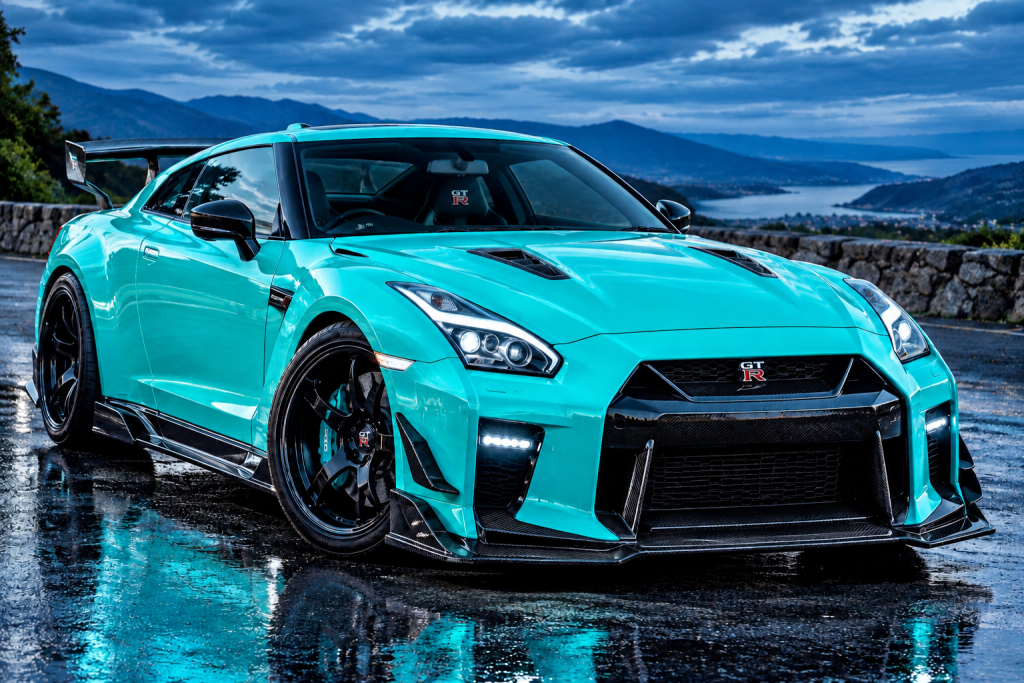
Few badges in the automotive world carry as much weight as three simple letters: GT-R. For more than five decades, the Nissan GT-R has been the giant-slayer of the performance car world — the machine that embarrassed Porsches on track, humbled supercars costing three times its price, and earned the nickname “Godzilla” through sheer, relentless dominance. This complete guide covers the full history of the Nissan GT-R, the legendary engines that powered every generation, each major version ever built, and the story behind the turquoise GT-R builds that stop traffic and dominate social media feeds around the world.
1. Nissan GT-R at a Glance
Before diving into five decades of history, here is the essential snapshot of the GT-R legend:
| Item | Detail |
| First GT-R | 1969 Nissan Skyline GT-R (PGC10) |
| Generations | Hakosuka, Kenmeri, R32, R33, R34, R35 |
| Most famous engine | RB26DETT — 2.6L twin-turbo inline-six |
| Final engine | VR38DETT — 3.8L twin-turbo V6 |
| Peak factory power | 600 hp (GT-R NISMO) |
| Drivetrain | ATTESA E-TS all-wheel drive |
| Nickname | Godzilla |
| R35 production run | 2007 – August 2025 (~48,000 units) |
2. The History of the Nissan GT-R
Skyline 2000GT-R “Hakosuka” — Where the Legend Begins
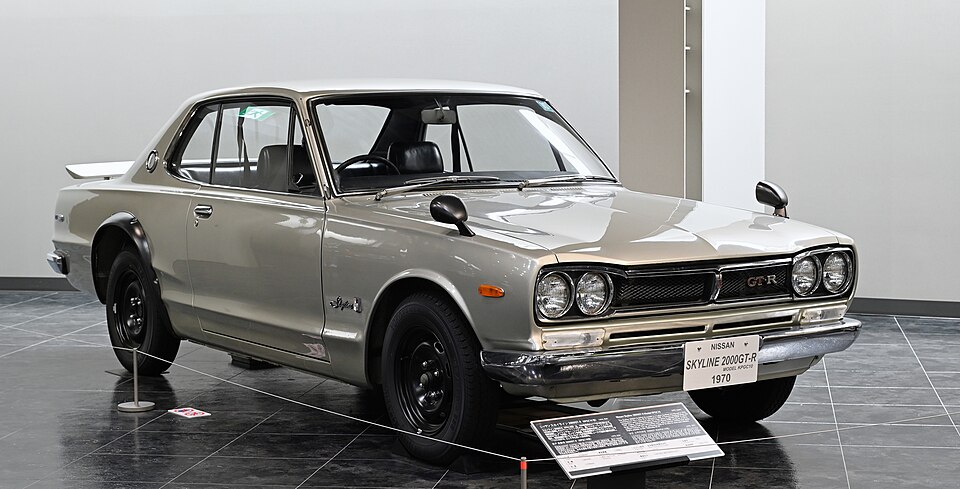
The GT-R story begins in February 1969, when Nissan launched the Skyline GT-R (chassis code PGC10) as a four-door sedan. It was powered by the S20, a 2.0-liter dual-overhead-cam inline-six derived directly from the engine in the Prince R380 race car, producing 160 horsepower — serious muscle for the era. The two-door coupe (KPGC10) followed in 1971, and today both are affectionately known by their nickname “Hakosuka”, a mash-up of the Japanese words for “box” (hako) and “Skyline” (sukairain). The Hakosuka GT-R proved itself immediately, racking up around 50 race victories in Japanese touring car competition and establishing the GT-R as a racing badge first and a road car second.
1973: The Kenmeri — The Rarest GT-R of All
The second-generation Skyline GT-R (KPGC110), nicknamed “Kenmeri” after a famous Japanese advertising campaign, arrived in 1973 — and vanished almost immediately. The global oil crisis killed demand for performance cars, and Nissan built only 197 Kenmeri GT-Rs before pulling the plug. That makes it the rarest production GT-R ever made, and surviving examples now command serious six-figure prices at auction. After the Kenmeri, the GT-R badge went silent for 16 years.
1989–1994: The R32 — Godzilla Is Born
Nissan revived the GT-R in 1989 with one mission: dominate Group A touring car racing. The R32 Skyline GT-R delivered the RB26DETT, a 2.6-liter twin-turbocharged inline-six officially rated at 276 horsepower (the self-imposed limit of Japan’s “gentlemen’s agreement” — real output was widely believed to be higher), paired with the ATTESA E-TS all-wheel-drive system and Super HICAS four-wheel steering. The result was a massacre. The R32 won all 29 races it entered in the Japanese Touring Car Championship and conquered Bathurst in Australia, where the local press — watching a Japanese monster devour the home heroes — gave it the immortal nickname “Godzilla”. More than 40,000 R32 GT-Rs were built.
1995–1998: The R33 — The Nürburgring Pioneer
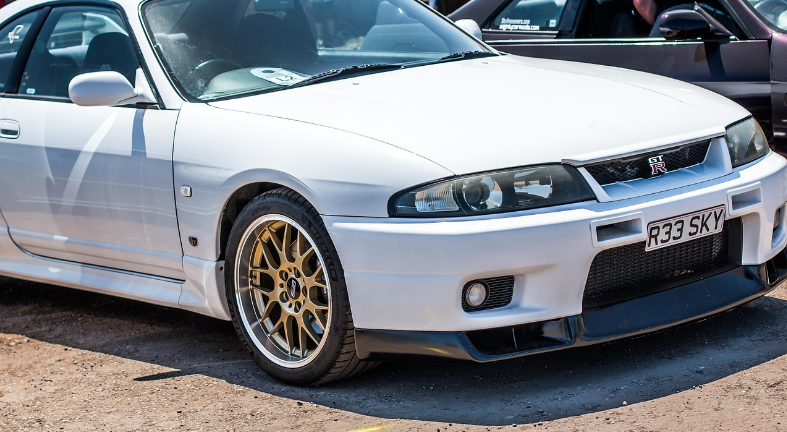
The R33 GT-R arrived in 1995: bigger, more stable and significantly faster. Its defining achievement came at the Nürburgring Nordschleife, where an R33 GT-R became the first production car to lap the Green Hell in under eight minutes (7:59). The R33 also refined the formula with an improved ATTESA E-TS Pro system featuring an active limited-slip differential on V-Spec models. Often overlooked between its more famous siblings, the R33 is now appreciated as the most comfortable and stable of the classic GT-Rs.
1999–2002: The R34 — The Pop Culture Icon
Ask anyone to picture a Skyline GT-R and they will picture the R34. Launched in 1999, it was shorter, stiffer and sharper than the R33, and packed technology that was years ahead of its time — including a 5.8-inch multifunction display showing boost pressure, oil temperature and lap times, extraordinary for 1999. The range spanned the standard car, the track-focused V-Spec and V-Spec II, and the ultra-rare 2002 Nür editions, built to close out production with a reinforced N1-based engine. When Paul Walker drove an R34 in “2 Fast 2 Furious” (2003), the GT-R became a global pop-culture phenomenon — and values have been climbing ever since.
2007–2025: The R35 — Godzilla Goes Global
In 2007 the GT-R dropped the “Skyline” name and became a standalone model sold worldwide: the Nissan GT-R (R35). Powered by the hand-built VR38DETT 3.8-liter twin-turbo V6 and a lightning-fast dual-clutch transaxle, the launch car made 473 horsepower and detonated the supercar hierarchy. Its 2008 Nürburgring lap of 7:29 — faster than the Porsche 911 Turbo of the day — sparked a famous feud with Porsche, and the GT-R kept evolving: 530 hp in 2011, 545 hp in 2013, 565 hp after the 2017 facelift, and 600 hp in the GT-R NISMO, whose N-Attack package lapped the Nordschleife in 7:08.679. After 18 years and roughly 48,000 cars, the final R35 — a Premium Edition T-Spec in Midnight Purple — rolled off the Tochigi production line on August 26, 2025, closing the chapter on one of the longest-running supercar generations ever built.
3. The Engines: The Heart of Godzilla
S20: The Racing Original
The original 1969 GT-R engine was a race-bred jewel: a 2.0-liter, 24-valve DOHC inline-six with triple side-draft carburetors, developed from Prince’s R380 racing program. With 160 hp at 7,000 rpm, it set the template for every GT-R engine to follow: high-revving, over-engineered and born on the track.
RB26DETT: The Tuners’ Holy Grail
The RB26DETT (R32, R33, R34) is one of the most legendary engines ever built. Its specification reads like a tuner’s wish list:
- 2,568 cc twin-turbocharged inline-six with an iron block and aluminum head
- Six individual throttle bodies for razor-sharp throttle response
- Officially 276 hp (gentlemen’s agreement); real-world output estimated at 320+ hp
- Cast-iron block strong enough to handle 600 hp with bolt-ons — and 1,000+ hp fully built
That enormous tuning headroom is why the RB26 became the foundation of the global GT-R tuning scene: what Nissan detuned for the brochure, the aftermarket unlocked with ease.
VR38DETT: One Man, One Engine
The R35’s VR38DETT took the philosophy further: a 3.8-liter twin-turbo V6 with plasma-sprayed cylinder bores, hand-assembled from start to finish by a single master craftsman — a “Takumi” — at Nissan’s Yokohama engine plant, with a plaque bearing the builder’s name on every engine. Output grew from 473 hp at launch to 565 hp in standard trim and 600 hp in the NISMO, which borrowed its turbochargers directly from the GT-R NISMO GT3 race car.
| Engine | Configuration | Power (official) | Used In | Years |
| S20 | 2.0L NA inline-six | 160 hp | Hakosuka, Kenmeri | 1969–1973 |
| RB26DETT | 2.6L twin-turbo inline-six | 276 hp | R32, R33, R34 | 1989–2002 |
| VR38DETT | 3.8L twin-turbo V6 | 473–600 hp | R35 | 2007–2025 |
4. GT-R Versions: Every Generation Explained
| Generation | Code | Years | Engine | Power | Defining Fact |
| Hakosuka | PGC10 / KPGC10 | 1969–1972 | S20 2.0L I6 | 160 hp | ~50 race wins; the original |
| Kenmeri | KPGC110 | 1973 | S20 2.0L I6 | 160 hp | Only 197 built — the rarest GT-R |
| R32 | BNR32 | 1989–1994 | RB26DETT | 276 hp | 29 wins in 29 JTCC races; “Godzilla” |
| R33 | BNR33 | 1995–1998 | RB26DETT | 276 hp | First production car under 8:00 at the ’Ring |
| R34 | BNR34 | 1999–2002 | RB26DETT | 276 hp | Pop-culture icon; Nür editions |
| R35 | DBA/4BA-R35 | 2007–2025 | VR38DETT | 473–600 hp | Global supercar; ~48,000 built |
Notable Special Editions and Trims
- R34 NISMO Z-tune (2005): NISMO’s ultimate GT-R — a hand-built 2.8-liter “Z2” engine with 500 hp and a carbon-fiber body. Just 20 cars; now worth well into six figures.
- R35 Premium Edition: the core model, ending production at 565 hp with a refined interior.
- R35 T-Spec (2021–2025): a heritage edition bridging Premium and NISMO, offered in Millennium Jade and Midnight Purple — including the very last R35 ever built.
- R35 Track Edition: NISMO-tuned suspension and a lighter, sharper chassis for circuit use.
- R35 GT-R NISMO (2014–2025): 600 hp, GT3-derived turbos, carbon aero and RAYS forged wheels — the ultimate factory GT-R.
- Nissan GT-R50 by Italdesign (2018): a 710-hp coachbuilt tribute limited to around 50 cars, priced at roughly $1.1 million.
5. The Turquoise GT-R That Steals Every Glance
No Factory Turquoise — and That’s the Point
Here is the truth that surprises most people: Nissan has never offered a factory turquoise GT-R. The closest factory shades are the R34’s legendary Bayside Blue — a vivid blue with turquoise undertones, revived for the R35’s 50th Anniversary edition in 2019 — and the green-tinged Millennium Jade of the V-Spec II Nür. Every true turquoise GT-R you have seen at a car show or on your feed is a custom creation — and that exclusivity is exactly why they steal every glance.
How the Turquoise GT-R Became an Internet Phenomenon
The turquoise GT-R is a product of the modern tuning scene. Builders combine a full turquoise, aqua or “Tiffany blue” wrap or paint job with the R35’s most aggressive hardware — Liberty Walk widebody kits, air suspension, deep-dish forged wheels and towering rear wings. These builds became fixtures of the SEMA show in Las Vegas and the global stance scene, and today they rank among the most shared GT-R content on Instagram, TikTok and YouTube. A stock GT-R draws attention; a turquoise widebody GT-R stops foot traffic dead.
Why Turquoise Works So Well on a GT-R
- Contrast: turquoise makes the GT-R’s black splitters, vents, diffusers and wings visually pop.
- Rarity: against a sea of black, white and silver supercars, a turquoise GT-R is instantly recognizable — you will never lose it in a parking lot.
- Photography: the color pops in photos and video, which is why turquoise builds dominate automotive social media.
- Attainability: a high-quality wrap costs roughly $3,000–$7,000 — the most dramatic transformation per dollar in the tuning world, and fully reversible.
6. Frequently Asked Questions
What does GT-R stand for?
GT-R stands for “Gran Turismo Racing”, from the Italian “gran turismo” — a car built for high-speed, long-distance performance, homologated for racing.
Why is the Nissan GT-R called Godzilla?
The Australian motoring press coined the nickname in the early 1990s after the R32 GT-R — a “monster from Japan” — dominated the Bathurst 1000 and crushed the local Ford and Holden heroes in touring car racing. The name stuck for over 30 years.
Is the Nissan GT-R discontinued?
Yes — for now. The final R35 GT-R was built on August 26, 2025, ending an 18-year production run of around 48,000 cars. Nissan has strongly hinted the GT-R name will return, showcasing the all-electric Hyper Force concept (with more than 1,300 horsepower) as a vision of Godzilla’s future.
What is the rarest Nissan GT-R?
The 1973 Kenmeri GT-R (KPGC110), with only 197 units built, is the rarest production GT-R. Among modern cars, the R34 NISMO Z-tune — just 20 built — is the most coveted, with auction prices deep into six figures.
Can you buy a turquoise GT-R from the factory?
No. Nissan has never offered turquoise as a factory color. The closest official shades are Bayside Blue and Millennium Jade. Turquoise GT-Rs are custom builds, most commonly created with a vinyl wrap rather than paint, keeping the original finish protected underneath.
How much does a Nissan GT-R cost?
At the end of R35 production, US pricing ranged from roughly $121,000 for the Premium edition to around $222,000 for the GT-R NISMO. On the collector market, R34s now routinely exceed $150,000, while Z-tunes and pristine Nür editions sell for far more.
7. Conclusion
From the boxy Hakosuka dominating Japanese circuits in 1969 to the final Midnight Purple R35 leaving the Tochigi line in 2025, the Nissan GT-R spent five decades proving one idea: engineering beats pedigree. Its engines — the S20, the immortal RB26DETT and the hand-built VR38DETT — became legends in their own right. Its versions span from the 197-unit Kenmeri to the 600-horsepower NISMO. And its culture lives on in builds like the turquoise GT-Rs that turn every gas station stop into a photoshoot. Godzilla may be resting, but the legend — and the glances it steals — isn’t going anywhere.