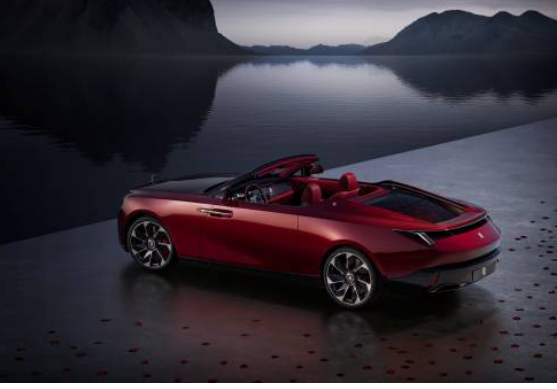
The Rolls-Royce La Rose Noire Droptail is one of the most ambitious expressions of contemporary automotive craftsmanship. Revealed in August 2023 as the first of four individually commissioned Droptail creations, this two-seat coachbuilt car combines sculptural bodywork, experimental finishes, intricate wood artistry, and a specially commissioned Audemars Piguet watch. Its identity revolves around a deeply personal inspiration: the Black Baccara rose.
At first glance, the car makes an impression through its dramatic proportions and rich red paintwork. Closer inspection reveals a much more elaborate story. The colors change with the light, the metalwork carries carefully controlled reflections, and the interior contains a composition of 1,603 individual pieces of wood. Even details that are difficult to see from a normal viewing angle contribute to the overall design.
Understanding La Rose Noire means looking beyond its widely reported price. Its significance lies in the way a client’s preferences became a complete automotive commission, extending from the exterior to the cabin and even to a matching Champagne Chest. This article explores the design, materials, craftsmanship, exclusivity, and estimated cost that make this Rolls-Royce such a remarkable creation.
What Is the Rolls-Royce La Rose Noire Droptail?
La Rose Noire Droptail is a bespoke, two-seat Rolls-Royce created through the manufacturer’s Coachbuild program. It belongs to a series of four Droptail commissions, with each car developed around the tastes and requirements of its commissioning clients. La Rose Noire was the first of those commissions to be publicly unveiled.
That distinction is important. The four cars share the Droptail project, but La Rose Noire has its own visual identity, materials, finishes, and personal narrative. Calling it simply one of four identical cars would overlook the individual character at the heart of the commission. Its rose-inspired aesthetic belongs specifically to this creation.
Rolls-Royce presented the car as an expression of the relationship between a husband and wife who lead a prominent international family. The manufacturer explained the emotional inspiration without publicly naming the commissioning clients in its unveiling announcement. Their preferences informed a coherent design language that links romance, French references, craftsmanship, and the pleasure of travel.
The Meaning Behind the La Rose Noire Name
The French name La Rose Noire translates to “the black rose.” It refers to the Black Baccara rose, a flower associated with exceptionally dark red petals. Under certain lighting conditions, those petals can appear almost black. Direct light reveals a richer pomegranate-red character, giving the flower a depth that appealed to both the clients and the design team.
According to Rolls-Royce, the rose was particularly cherished by the mother of the commissioning family. Its significance therefore reaches beyond a decorative theme. It represents a personal reference that the designers could translate into color, material, and atmosphere throughout the car.
The flower also offered an unusually flexible starting point. Its shifting appearance suggested an exterior finish that would change as the viewing angle changed. Its petals inspired the interior artwork, while its romantic associations informed the naming of the colors. Instead of repeating an obvious flower emblem across every surface, the commission expresses the inspiration through several different design decisions.
The Role of Rolls-Royce Coachbuild
Coachbuilding allows an automotive commission to develop around a client’s individual vision at a deeper level than choosing conventional paint colors, upholstery, and trim. In a project such as Droptail, the shape of the car, the arrangement of materials, and the treatment of special features become part of a close collaboration between the clients and the manufacturer.
This approach draws on the historic practice of creating bodies tailored to individual customers. Its modern expression brings together design, engineering, material development, and hand craftsmanship. The result still has to function as a car, even when its visual and tactile details are developed with the attention usually associated with decorative art.
La Rose Noire illustrates that balance particularly well. Its elaborate woodwork must fit around the occupants and across the cabin’s surfaces. Its removable watch needs a practical mounting system. Its special roof must contribute to the shape of the car while also changing the experience inside. These requirements make the commission more complex than a collection of separately chosen luxury accessories.
Exterior Design: A Dramatic Two-Seat Silhouette
The Droptail’s two-seat layout gives La Rose Noire a distinctive presence. Its proportions concentrate attention on the relationship between the long front section, the intimate cabin, and the sculpted rear bodywork. The result feels more personal than a large luxury saloon while retaining the visual authority associated with Rolls-Royce.
The silhouette is especially important because the car can be experienced with or without its hardtop. In open form, the cabin and rear treatment become prominent parts of the exterior composition. With the roof installed, the profile becomes more enclosed and dramatic. The design therefore has to remain convincing in two visibly different configurations.
La Rose Noire’s exterior also rewards movement around the car. Changes in perspective reveal variations in the paint and the reflections of its darker metal finishes. Rather than relying entirely on contrast between bright chrome and body color, the design uses a more restrained combination of red, shadow, and polished surfaces to build its character.
True Love and Mystery: Two Colors With a Personal Story
The commission’s principal colors are named True Love and Mystery. Rolls-Royce describes True Love as a red shade connected to the romance the clients wanted the car to express. Mystery is the darker tone, inspired by the Black Baccara rose’s changing appearance when viewed from different angles.
These names help explain the design, but the colors also perform a practical visual role. A consistent palette carries the floral inspiration through the bodywork, wheels, seats, and smaller details. That consistency prevents the numerous bespoke elements from feeling disconnected, even when they involve very different materials and methods of production.
The relationship between the two shades is more subtle than a simple red-and-black combination. Dark surfaces reveal red undertones in sunlight, and lighter red elements carry their own variations in depth and reflection. The effect connects the car to the living flower that inspired it, whose appearance is shaped by light rather than by a single fixed color.
A Paint Process Refined Through 150 Iterations
The exterior is finished in True Love red, but achieving the desired appearance required the development of a new paint process. Rolls-Royce reported that its surface-finish specialists perfected the process through 150 iterations. That figure refers to the development of the finish, rather than the number of layers applied to the completed car.
The final approach uses a base coat whose color the manufacturer has kept confidential, followed by five layers of clear lacquer. Each lacquer layer contains a slightly different red tone. Together, they create the depth and variation required to echo the Black Baccara rose’s changing appearance.
This detail explains why photographs may not fully capture the finish. A flat image records one set of lighting conditions and one angle, while the actual surface can reveal different effects as the viewer moves. The paint is therefore part of the car’s experience, not simply a color specification. Its development reflects the importance the clients and designers placed on translating a natural reference into a durable automotive surface.
Hydroshade: The Dark Finish on the Metalwork
La Rose Noire’s metal detailing introduces another specially developed finish, called Hydroshade. Rolls-Royce named it for its liquid visual quality. The finish gives selected metal components a dark yet reflective appearance, supporting the exterior’s dramatic palette without eliminating the richness that polished metal brings to the design.
The manufacturer explains that Hydroshade is produced through a chrome-plating process rather than paint. A specific chrome electrolyte is introduced during plating and co-deposited onto the stainless-steel substrate. The resulting layer is approximately one micron thick, making this a precise surface treatment rather than a heavy coating.
The same visual approach extends to selected interior metal details, which were polished by hand to a high-gloss finish. Carrying Hydroshade into the cabin helps connect the inside and outside of the car. It also demonstrates how a commission can use a consistent aesthetic across different environments without applying exactly the same material to every surface.
Hidden Color in the Grille and Front Air Intake
Some of La Rose Noire’s most distinctive details are deliberately discreet. True Love paint was hand-applied to the reverse surfaces of the Pantheon grille’s vanes. The color is visible through indirect reflection, adding an unexpected red accent without making the front of the car appear overtly patterned.
The lower front air intake is similarly elaborate. Rolls-Royce describes a digitally designed component, 3D printed in a lightweight composite, that incorporates 202 hand-polished stainless-steel ingots. Each of these was hand-painted in the True Love hue. The combination brings modern production methods together with substantial manual finishing.
These details show how the commission uses two different levels of visual impact. The overall shape and color create an immediate impression, while smaller features emerge during close inspection. For the owners, that gives the car lasting interest: familiar surfaces can continue to reveal the decisions and workmanship behind their appearance.
The 22-Inch Wheels and Their Changing Finish
La Rose Noire’s 22-inch wheels contribute to its substantial visual presence. Their finish uses the darker Mystery color, which can appear black at a distance before revealing shimmering dark red undertones in sunlight. This treatment continues the rose-inspired interaction between shadow and color at the corners of the car.
The paint is applied across the rim’s surface before selected areas are removed through a high-precision diamond-milling process. Exposing and polishing portions of the underlying alloy creates accents that emphasize the wheel’s design. The result combines dark painted surfaces with brighter details shaped directly from the base material.
Wheels are sometimes treated as a separate styling choice, but here they form part of the complete color story. Their changing appearance supports the bodywork rather than competing with it, while the polished accents add definition. This makes them another example of how the commission develops one inspiration across multiple components.
A Removable Hardtop With Electrochromic Glass
The removable hardtop gives Droptail two distinct characters. Without it, La Rose Noire becomes an open roadster. With it fitted, the car takes on the appearance of a dramatic coupé. Rolls-Royce gave this commission a particularly low roof treatment and a longer, faster rake to reinforce its assertive silhouette.
The roof also includes an electrochromic glass section. At the touch of a button, the glass changes its level of transparency, allowing occupants to alter their connection with the sky above. This introduces an additional way to change the atmosphere inside the car while the hardtop remains in place.
Behind the roof, an ingot carries the motor car’s name, a feature Rolls-Royce identified as a first for the marque. Together, the shape, glass, and name detail make the hardtop an important part of La Rose Noire’s identity. It serves an aesthetic and experiential purpose in addition to providing cover for the cabin.
Inside the Cabin: An Abstract Composition of Rose Petals
The centerpiece of the interior is its remarkable parquetry, a decorative wood composition inspired by falling rose petals. Rolls-Royce described it at the unveiling as the most complex expression of parquetry it had created. The work stretches from the rear shawl panel through the doors and onto the expansive fascia.
Its arrangement wraps around the occupants rather than appearing as a small isolated decorative insert. This placement makes the artwork fundamental to the experience of sitting inside the car. The cabin becomes the setting for a continuous composition, with the surrounding leather and metalwork chosen to support its colors and textures.
The petal theme remains abstract. Dark and gray wood pieces create the background, while red elements suggest petals scattered across it. That abstraction is important to the design’s character: it allows the surface to be appreciated both as an intricate geometric pattern and as an expression of the commissioning family’s floral inspiration.
How the 1,603-Piece Wood Artwork Was Constructed
The parquetry contains 1,603 individual wood veneer triangles. Of these, 1,070 form the symmetrical background, while 533 red pieces are positioned asymmetrically to suggest falling petals. The clients specifically requested asymmetry in the petal arrangement so that it would convey a natural, organic scattering.
The wood is Black Sycamore sourced in France, providing another connection to the commission’s French references. Each triangle was cut, sanded, and positioned by hand. The light and dark gray tones come from the wood’s natural appearance, using veneer from logs with different figures, rather than staining every piece to create those variations.
Paint was used to produce the red pieces. Rolls-Royce also reported spending a year developing a lacquer formula intended to protect their color from fading. This is a useful reminder that the artistry of an automotive interior depends on material performance as well as appearance. The chosen effect must be preserved within a car that will encounter changing light and environmental conditions.
Why the Parquetry Required Such Intense Concentration
The development of the parquetry involved nearly two years of experimentation and craftsmanship, according to Rolls-Royce. Creating the artwork itself took more than nine months. Those timeframes describe related stages of the work and should not be treated as interchangeable estimates for the same activity.
The assembly demanded exceptional concentration from the single craftsperson responsible. Rolls-Royce reported that the artisan worked in one-hour sessions, for no more than five hours in a day, to maintain the focus required for precise execution. The craftsperson also spent weeks working in silence in a sound-insulated space to reduce distractions.
These working conditions offer a concrete explanation for the project’s complexity. A composition with so many individually shaped pieces depends on the accuracy of countless small decisions. Its quality comes from the relationship between each element and the overall pattern, so a convincing result requires both sustained attention to detail and a clear understanding of the complete design.
Leather Upholstery That Continues the Rose Theme
The two seats incorporate dark red Mystery leather and lighter True Love leather at their edges. Both finishes carry a subtle copper shimmer, evoking the pearlescent quality associated with the Black Baccara rose’s petals. The upholstery therefore contributes to the same shifting visual language as the exterior paint.
Leather also changes the balance of the cabin. The parquetry introduces angular geometry and extraordinary visual detail, while the seats provide softer surfaces and a more intimate setting. Their coordinated colors allow the materials to work together without making every component equally elaborate.
This balance helps explain the appeal of the interior. Its richness comes from several kinds of craftsmanship, but the palette keeps them connected. Occupants experience the commission through the touch of leather, the depth of wood, and the reflection of polished metal, making the cabin’s character broader than the impressive number of pieces in its most famous feature.
The Bespoke Audemars Piguet Royal Oak Concept Watch
La Rose Noire’s fascia incorporates a specially commissioned Audemars Piguet timepiece. The watch is a 43 mm Royal Oak Concept Split-Seconds Chronograph GMT Large Date, powered by the self-winding Calibre 4407 movement. Its complications include a flyback chronograph and a split-seconds mechanism.
Its appearance was coordinated with the car. Red counters and a red inner bezel contrast with a black openworked dial, while rhodium-toned bevels add definition. The result brings the visual language of fine watchmaking into the cabin without abandoning the color scheme established elsewhere in the commission.
The watch also gives the dashboard a personal focal point. It connects two specialist crafts that share an interest in material quality, precision, and meticulous finishing. Its significance comes from that integration as much as from its individual specifications: it was commissioned to participate in the design of this particular car.
A Dashboard Watch That Can Also Be Worn
The clients requested that the Audemars Piguet watch could be removed from the dashboard and attached to a strap for wearing. Meeting that requirement called for a bespoke mounting solution. Rolls-Royce developed a powered clasp mechanism that presents the timepiece at the touch of a button.
When the watch is removed, the opening is covered with a titanium openworked blank featuring a white-gold coin engraved with a rose. Audemars Piguet artisans sculpted the engraving by hand. This ensures that the dashboard retains a considered appearance even when the owner is wearing the watch elsewhere.
Rose engravings on the Bespoke Audio speaker frets echo the same motif. The connection between the watch, its replacement element, and the surrounding details makes the installation feel fully resolved. It also illustrates a practical characteristic of the commission: the design anticipates how an owner might use an object instead of treating it solely as a fixed display piece.
The Matching Champagne Chest
The commission extends beyond the car through a matching Rolls-Royce Champagne Chest. Created to stage the family’s exclusive vintage of Champagne de Lossy, the chest uses coordinated colors and materials, including rose-petal parquetry. It applies the car’s design language to an object associated with travel, hospitality, and celebration.
At the press of a button, the chest opens to reveal a champagne set with hand-blown crystal flutes. Its lid converts into a serving tray made from bookmatched open-pore Black Sycamore wood. A brushed and laser-cut stainless-steel inlay includes a design of the château, giving the serving surface its own specific connection to the champagne.
The sides feature matching parquetry and open to reveal two hammocks that cradle the special-edition bottles. These details make the chest a substantial companion commission. It demonstrates how the clients’ chosen theme could be carried into another functional object while maintaining the same attention to materials and presentation.
How Much Does the Rolls-Royce La Rose Noire Droptail Cost?
Media coverage has widely associated La Rose Noire Droptail with an estimated price of approximately $30 million. That figure helps explain the attention the car received, but Rolls-Royce did not disclose the exact commission price in its official unveiling announcement. It should therefore be presented as a reported estimate.
The distinction matters because a private coachbuilt commission does not have a conventional published retail price. Its final cost can reflect extensive design development, unique material processes, engineering requirements, and highly specialized labor. Without an official disclosure, an outside reader cannot confidently separate those contributions or determine the precise commercial arrangement.
La Rose Noire is frequently described as one of the world’s most expensive new cars, and some reporting has placed it at the top of that category. A definitive ranking is difficult when comparable private commissions also lack verified public prices. The more defensible conclusion is that its reported cost places it among the most extraordinary automotive commissions discussed publicly.
Why This Commission Matters to Automotive Design
La Rose Noire demonstrates that a car can communicate a personal story through its materials and construction. The rose inspiration is visible in the palette, but it also affects the way the designers arranged the wood, developed finishes, and integrated smaller details. That consistency gives the commission an identity that extends beyond its price or rarity.
The project also shows how traditional craft can coexist with modern techniques. Hand-cut veneer sits alongside digitally designed and 3D-printed components. Hand-polished metalwork accompanies an electrochromic glass roof and a powered watch mechanism. Each process serves a specific design or functional requirement rather than appearing simply to demonstrate technical novelty.
For automotive enthusiasts, this makes La Rose Noire an interesting study in integration. The most impressive aspect is not any single detail in isolation. It is the way those details form a usable vehicle with a coherent visual and emotional character, despite the enormous variety of skills involved in producing them.
Frequently Asked Questions
Is La Rose Noire Droptail a one-off car?
La Rose Noire is an individually commissioned creation within the four-car Droptail project. Its colors, rose-inspired parquetry, timepiece installation, and associated details define this specific commission. It is best described as a unique interpretation of Droptail rather than one of four identical examples.
Who owns La Rose Noire Droptail?
Rolls-Royce’s official unveiling described the commissioning clients as a husband and wife at the head of a prominent international family. The announcement did not identify them by name. Speculation about their identity should not be presented as confirmed ownership information.
When was the car revealed?
Rolls-Royce published its official unveiling announcement on August 20, 2023. La Rose Noire was introduced as the first of four unique Droptail commissions, establishing the initial public expression of the project.
How many pieces of wood are used in the interior?
The parquetry contains 1,603 veneer triangles: 1,070 background elements and 533 red pieces representing scattered rose petals. The composition uses Black Sycamore sourced in France, with natural wood variations contributing to the background’s different tones.
Does the car have a removable roof?
Yes. La Rose Noire has a removable hardtop that changes its appearance from an open roadster to a coupé-like form. The roof also incorporates electrochromic glass, allowing occupants to change the transparency of its glass section at the touch of a button.
Is the $30 million price official?
No official exact price was published in the Rolls-Royce unveiling announcement. Approximately $30 million is a widely reported media estimate. Any article using that figure should identify it as reported rather than presenting it as a manufacturer-confirmed retail price.
A Lasting Expression of Personal Luxury
The Rolls-Royce La Rose Noire Droptail brings together an unusually detailed combination of personal inspiration, surface development, wood artistry, and specialist craftsmanship. Its design begins with the Black Baccara rose and follows that reference through changing red finishes, natural wood tones, a removable watch, and a matching Champagne Chest.
Its importance ultimately lies in the completeness of that idea. A flower meaningful to the commissioning family became the foundation for a roadster whose details support one another across different materials and functions. La Rose Noire offers a compelling example of what modern coachbuilding can achieve when a client’s story is developed into a complete automotive work.
Editorial Sources
Primary source: Rolls-Royce Motor Cars, “Rolls-Royce Unveils La Rose Noire: The First Droptail Coachbuild Commission,” official press release, August 20, 2023.
Additional source: Rolls-Royce Motor Cars, official La Rose Noire Droptail Coachbuild presentation.
Reported price context: Business Insider, “Someone in California Is Now Driving a Rolls-Royce That Cost $30 Million,” August 2023; and Spear’s coverage of the La Rose Noire Droptail unveiling. These media reports provide price estimates, not an official confirmation of the commission’s exact cost.