By Wilton de Jesús de León Tineo | worldmotorcars.info
The SUV That Changed a Brand
Every car company has a model that explains who it is. For Porsche it is the 911. For Land Rover it is the Defender and the Range Rover. For Volvo, in the twenty-first century, it is the XC90. This large, calm, family-friendly SUV has carried the Swedish brand through a change of owners, a change of design language, a change of technology and even a change of identity, from a maker of boxy wagons to a global premium player aimed at the cleanest, most thoughtful end of the luxury market.
The XC90 has now been on sale for more than two decades. It has lived through two completely different generations, one of the longest production runs in the modern SUV world, the arrival of plug-in hybrids, the shift to touchscreens and software updates, and the dawn of electric cars. Along the way it has won awards, helped save a company and become one of the most recognizable silhouettes on the road, with its tall vertical taillights and the famous “Thor’s Hammer” headlights.
This article is a story, not a test drive. We follow the Volvo XC90 from the first sketches of the early 2000s through the original model, the long wait for a successor, the dramatic reinvention of 2014 and 2015, the mild-hybrid and Google-powered years, and finally the 2026 model that stands in showrooms today. Along the way we look at the people, the platforms, the engines and the ideas behind it. If you are a longtime Volvo fan, a curious car lover or a buyer who wants to understand the history behind the badge, this is the full story.
A note on accuracy: production dates, model names and specifications differ slightly between countries, and Volvo has changed trim and powertrain names many times. Where details are uncertain, we describe them in general terms rather than inventing precise figures.
Before the XC90: Volvo, Safety and an SUV Problem
To understand why the XC90 mattered, you need to understand the company that built it. Volvo was founded in Gothenburg, Sweden, in 1927, and it built its reputation on a simple idea: cars should protect the people inside them. In 1959 the company introduced the modern three-point seat belt, designed by engineer Nils Bohlin, and made the patent freely available to other manufacturers because it believed it would save lives. That decision, more than any advertising campaign, shaped how the world saw the brand for decades.
By the 1990s Volvo was known for durable sedans and large station wagons, loved by families, architects, professors and anyone who preferred substance to show. But the market was changing quickly. In North America and across the world, buyers were moving from sedans and wagons to sport utility vehicles. The Ford Explorer, the Jeep Grand Cherokee, the Mercedes-Benz M-Class and the BMW X5 were reshaping what a family car looked like. A Swedish brand that stood for safety and practicality had no tall, seven-seat vehicle to offer.
Volvo had a stopgap in the form of high-riding wagons such as the V70 Cross Country, but it did not feel like a true SUV. The company needed something bigger and bolder, a vehicle that could carry a family, tow a trailer, handle a snowy road and still carry the Volvo safety promise. That vehicle would become the XC90.
The Ford era
There was one more factor. In 1999, Ford Motor Company bought Volvo Cars, adding it to a portfolio of premium brands. The purchase gave Volvo access to more money and more engineering resources, even though not every part of that arrangement was easy. The XC90 would be one of the first major new products to emerge from this period, and it would help prove that Volvo could grow without losing its character.
2002: The First-Generation XC90 Arrives
Volvo revealed the XC90 at the Detroit Auto Show in January 2002, and the timing was perfect. The brand had finally entered the SUV segment with a vehicle that looked and felt unmistakably Swedish. It was tall, rounded and friendly, with clean surfaces, a high beltline and strong shoulders, and it offered something most rivals still did not: seven seats as a serious option in a premium package.
Platform and design
The first-generation XC90 was built on a platform developed for Volvo’s larger cars, which it shared with models such as the S80 and the V70 in spirit if not entirely in detail. It used a car-like unibody structure rather than a traditional truck frame, which gave it a smooth, comfortable ride and good handling for its size. At a time when many SUVs were crude and truck-based, the XC90 felt more like a tall station wagon, and that was a major part of its appeal.
The design was penned under the direction of the company’s design team in Gothenburg and was recognizable immediately: a bold grille with the diagonal Volvo iron mark, shoulders that flared over the wheels, and tall taillights wrapped up the corners. It felt modern, but not aggressive.
Safety from day one
Safety was the brand’s mission, and the XC90 was designed to show that an SUV could be safe, not just big. SUVs of the time were criticized for rollover risk, so Volvo developed technology to address it. The XC90 was among the first SUVs offered with a roll stability system that used sensors to detect an impending rollover and apply braking or reduce engine power to help the driver stay in control. The body structure included reinforced areas designed to maintain the integrity of the passenger compartment in a rollover, and the XC90 also incorporated Volvo’s whiplash-protection seat design, side airbags and inflatable curtains.
The seating layout was also thoughtful. The XC90 was offered with seven seats, including a third row that folded flat into the floor, and the second-row seats could slide and fold in multiple ways. Some versions even included an integrated child booster cushion in the second row, a feature that showed Volvo understood who was actually buying the car.
Engines and driving
At launch, the engine range centered on turbocharged five-cylinder and six-cylinder petrol engines, with a smooth automatic transmission and, in many markets, all-wheel drive. There was a strong version with a twin-turbo six-cylinder engine for buyers who wanted more power, and in Europe there was a popular five-cylinder turbodiesel that became a staple of family life across the continent. The driving experience was relaxed and comfortable rather than sporty, which suited the vehicle’s purpose.
The reaction
Critics and customers responded with enthusiasm. The XC90 was praised for its comfort, its safety technology, its interior quality and its flexible seating. Sales were strong from the beginning, and the vehicle quickly became one of Volvo’s best-selling models. For a company that had worried about its place in the SUV world, it was a triumph.
2005 and Beyond: The V8, the Updates and the Long Middle Years
The original XC90 was not a one-hit wonder. Over the following years Volvo kept improving and expanding it, and the model remained in production far longer than a typical SUV.
The V8 experiment
In 2005 Volvo added a V8 engine option, developed with the help of Yamaha, a company better known for motorcycles and musical instruments. The compact V8 was smooth and powerful, and it gave the XC90 a new level of performance. It was a surprising move for a brand known for sensible four- and five-cylinder engines, but it showed Volvo could build a flagship SUV with real muscle. A version with a sporty R-Design package followed, adding firmer suspension and sportier styling.
Updates and equipment
A significant refresh arrived in the middle of the decade, bringing updated styling, a new interior look and improved technology. Over time Volvo added features such as blind-spot information, improved infotainment, better lighting and more powerful engines. The diesel version in Europe was updated repeatedly, becoming more efficient and more refined.
An unusually long life
What made the first-generation XC90 remarkable was its longevity. Most SUVs are replaced after five to seven years, but this one soldiered on for roughly twelve. The reason was partly a matter of circumstance: Volvo changed hands, budgets were tight and the company needed to plan a completely new platform for its next generation. The old XC90 kept selling, however, because it did its job well and still looked handsome. By the end it had become one of the most successful models in Volvo’s history and had sold in the hundreds of thousands.
Long production runs are not unusual for icons: the Nissan GT-R followed a similar path, evolving through many engine updates and versions, which you can explore in our Nissan GT-R history guide.
2010: A New Owner and a Big Decision
In 2010, Ford sold Volvo Cars to Geely Holding, a Chinese automotive group that had been growing rapidly. The sale raised questions about the brand’s future, but Geely turned out to be an unusually supportive owner. It gave Volvo the freedom and the funding to develop a new generation of vehicles from the ground up, rather than trying to keep stretching old platforms.
The plan was ambitious. Volvo would create an entirely new modular architecture called SPA, short for Scalable Product Architecture, which could underpin large and medium-sized cars of many kinds. It would develop a new family of efficient four-cylinder engines, called Drive-E, to replace the older five- and six-cylinder units. And it would introduce a new design language and a new digital interface. The first model to receive all of these things would be the new XC90, and the pressure on that car was enormous. If it failed, the entire plan could unravel.
Why the XC90 had to go first
Choosing the XC90 as the first SPA model was a bold move. Large SUVs are expensive, high-profit vehicles, and the XC90 was the most important Volvo in the American market. By launching its most prestigious product first, the company was making a statement: the new Volvo would compete at the top, not just at the bottom.
2014–2015: The Second-Generation XC90 Changes Everything
The second-generation XC90 was revealed in Stockholm in August 2014 and began arriving in showrooms in 2015. It was not just a new SUV. It was the car that redefined Volvo.
A new face and a new language
The design was led by Thomas Ingenlath, who would later become the CEO of Polestar, and it introduced what is now called the Scandinavian design language. The most recognizable feature was the “Thor’s Hammer” daytime running light, a T-shaped LED signature that gave the car a distinctive look in any rearview mirror. The grille was bigger and more upright, the proportions were longer and more elegant, and the overall look was calm, confident and expensive.
The interior was just as radical. Instead of a dashboard crowded with buttons, the new XC90 had a large vertical touchscreen in the center that controlled most functions, a digital instrument display and a minimalist layout with natural materials such as wood, metal and fine leather. It looked like nothing else in the segment, and many buyers loved it.
SPA and Drive-E
Under the skin, the XC90 was built on the new SPA platform, which allowed for a lighter, stiffer structure with a high proportion of high-strength steel. It also meant a new suspension design, including an optional air suspension and a composite transverse leaf spring at the rear on some versions, which saved space and improved comfort. All engines were four-cylinder turbocharged units from the Drive-E family, displacing two liters, with turbocharging or a combination of turbocharging and supercharging. This was controversial at first, because buyers expected a premium SUV to have at least a six-cylinder engine. Volvo bet that people would accept smaller engines if they were smooth, powerful and efficient.
The T8 Twin Engine
The most dramatic engine was the T8 plug-in hybrid, then called Twin Engine. It combined the four-cylinder petrol engine with an electric motor on the rear axle and a battery, offering around 400 horsepower and the ability to drive short distances on electricity alone. In 2015, a plug-in hybrid large SUV from a mainstream premium maker was a bold and unusual product, and it announced that Volvo was serious about electrification long before many rivals.
Safety, again
The new XC90 set a fresh benchmark for safety. It introduced run-off road mitigation, which could tighten the seat belts and absorb energy in the seats if the car left the road unintentionally, and it included City Safety with automatic braking, a system that would evolve over the following years to detect pedestrians, cyclists and large animals. Volvo also repeated its long-term goal of eliminating serious injuries and fatalities in its new cars, a mission that continues to guide the company.
Awards and success
The second-generation XC90 won major awards, including North American Truck of the Year for 2016, and it became a sales success, especially in the United States and Europe. It also shifted perceptions of the brand. Suddenly, Volvo was not just the sensible choice but the stylish choice too.
2016–2019: Growing the Family
The success of the XC90 gave Volvo the confidence to roll out the same technology across its range. The smaller XC60, the new S90 and V90 and the compact XC40 would all adopt the same design language and related technology, and the XC90 became the model that everybody compared them to.
Trims and personalities
During this period the XC90 was offered in several trims. Momentum was the sensible entry point, R-Design added a sportier appearance and Inscription emphasized luxury with wood trim and softer leather. A long-wheelbase Excellence version appeared in some markets, with a lounge-like four-seat layout designed for chauffeured travel, which helped push the XC90 into a higher price bracket and attract buyers who would normally buy a luxury sedan.
Tech improvements
Over these years the XC90 gained Pilot Assist, a semi-autonomous driving feature combining adaptive cruise control and steering assistance, along with improved infotainment and connectivity. Software updates arrived periodically, and Apple CarPlay and Android Auto became available. These changes helped the vehicle stay competitive in the fast-moving technology race.
A cultural shift
By the end of the decade, the XC90 was a status symbol that people chose because they wanted to, not because they needed to. It attracted younger families, design-conscious buyers and drivers who had previously never considered a Volvo. It had succeeded in its mission to make the brand desirable.
2019–2024: Mild Hybrids, Recharge and the Google Era
As the 2020s approached, the car industry faced pressure from regulators, customers and rising fuel costs to reduce emissions. Volvo responded by making electrification a central part of its identity, and the XC90 was a key participant.
Mild hybrids arrive
Around the 2020 model year, Volvo updated the XC90 with a mild-hybrid system, a 48-volt setup that assists the engine, smooths the start-stop function and improves efficiency without requiring the owner to plug anything in. This gave rise to the B5 and B6 names that are still used today, referring to different power levels of the same turbocharged four-cylinder engine. The change simplified the engine lineup, and it marked the end of the supercharged-and-turbocharged engines that had been a signature of the early SPA years in many markets.
The Recharge name
The plug-in hybrid XC90, previously called Twin Engine, was rebranded as Recharge, and the T8 name became more prominent. Volvo expanded the battery, improved the electric range and positioned the plug-in version as the flagship of the lineup. In many markets, it became the most expensive and most desirable XC90.
A speed limit and a safety statement
In 2019, Volvo made headlines by announcing that its new cars would be limited to a top speed of 180 km/h, or about 112 mph, in line with its long-term safety goals. It was a symbolic gesture, but it showed the company was willing to challenge industry norms in the name of safety. The XC90 was among the models affected, and the move reinforced the brand’s image as the car company that actually meant what it said about protecting people.
Software takes over
During the early 2020s, Volvo began introducing an infotainment system based on Android Automotive, with Google services built into the car. This was a major shift: instead of a custom Volvo interface, the car ran an operating system with Google Maps, Google Assistant and an app store. Over-the-air updates allowed the company to add features and fix problems remotely. The XC90 received this technology as part of its ongoing updates, helping a design that was already several years old feel modern again.
An unusually long second act
By 2024, the second-generation XC90 had been on sale for nearly a decade, a remarkable lifespan in a segment where rivals are redesigned every six or seven years. Volvo had kept it competitive through a series of updates rather than a full redesign. The company was busy building a successor of a different kind, and that is where the story takes an electric turn.
The EX90 and the Question of the XC90’s Future
In late 2022, Volvo revealed the EX90, a fully electric seven-seat SUV positioned as the spiritual successor to the XC90. It brought a new design language, a new software-defined architecture and advanced safety technology including lidar. Production is centered on the company’s plant in South Carolina, and the EX90 began reaching customers in 2024.
Many observers assumed that the EX90 would simply replace the XC90, and Volvo’s original strategy suggested that the company would become a fully electric brand by 2030. But the market evolved. Demand for electric vehicles grew more slowly than predicted in some regions, and plug-in hybrids and mild hybrids remained popular. Volvo adjusted its plans and decided to keep combustion-based and plug-in models in its lineup for longer. The XC90 got a reprieve, and with it came a meaningful update.
2025–2026: The Refreshed XC90 for the 2026 Model Year
The 2026 Volvo XC90 was revealed in 2025 as a significant refresh of a well-loved model. It did not change the car’s basic structure or its core powertrains, but it brought the styling and the digital experience in line with the new EX90.
A new face
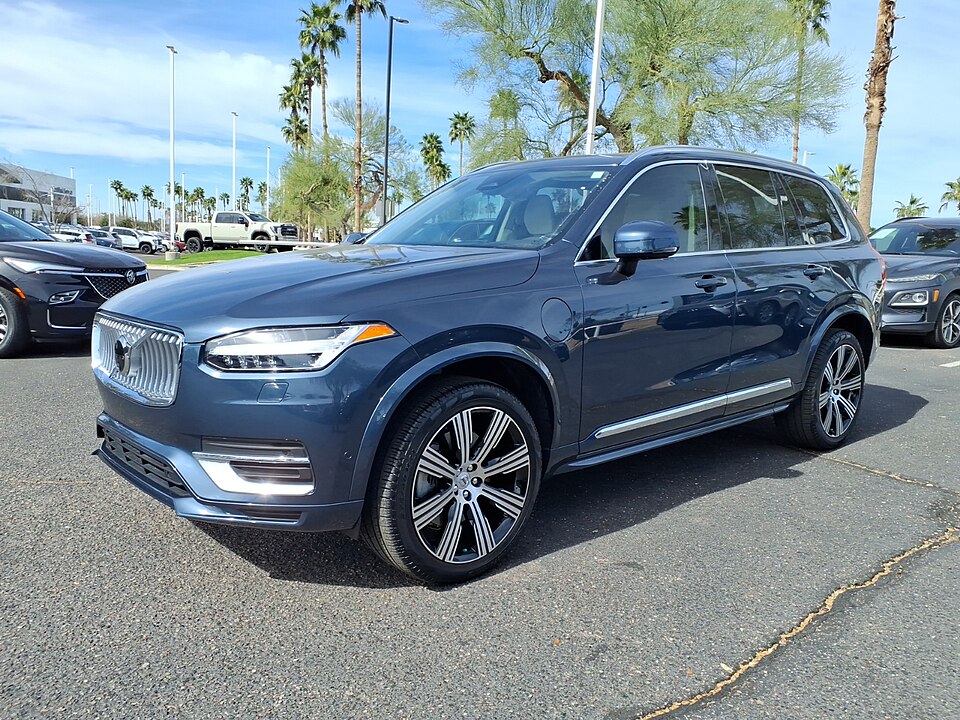
The front end was redesigned with a cleaner grille and updated lighting that echoes the EX90, while keeping the Thor’s Hammer signature. New wheel designs and colors rounded out the visual changes. The result was a more modern XC90 that remained instantly recognizable.
A modern cabin
Inside, the car received a larger central touchscreen with a faster processor, Google built-in software, new upholstery options and wireless phone charging. The layout remained minimalist, with the same calm Scandinavian character that has defined the model since 2015.
Comfort-focused engineering
Volvo reported a new integral link at the rear of the car to improve stability and traction, particularly when towing. Journalists who drove the updated car reported it feels noticeably more comfortable than before. Towing capacity remains around 5,000 pounds in the US, and up to roughly 2,400 kg on a braked trailer in some other markets.
The powertrains
The 2026 lineup is built around a 2.0-liter turbocharged four-cylinder engine. The B5 mild hybrid produces roughly 247 horsepower, the B6 where offered produces around 300, and the T8 plug-in hybrid pairs the engine with an electric motor and an 18.8 kWh battery for much more power and roughly 32 to 35 miles of electric range under US estimates. Output figures for the T8 differ by market, so owners should check the specifications for their own country.
Trims and pricing today
In the United States, buyers can choose between Core, Plus and Ultra trims, with a new T8 Ultra Dark Theme added for 2026 and remote start made standard on plug-in versions. Pricing begins in the low $60,000s for the B5 Core and in the mid-$70,000s for the T8, climbing to the mid-$80,000s for the top T8 Ultra versions. In the UK the car starts at roughly £66,000, and in Australia the lineup was trimmed to two variants for 2026. Six-seat layouts with individual second-row chairs are available on selected T8 trims.
How the XC90 Has Changed: Three Eras Side by Side
| Feature | First generation (2002–2014) | Second generation (2015–2025) | 2026 refresh |
|---|---|---|---|
| Design language | Rounded, friendly, early-2000s styling | Scandinavian design, Thor’s Hammer lights | Cleaner face inspired by the EX90 |
| Engines | Five- and six-cylinder, later V8; diesels in Europe | Two-liter four-cylinders, B5, B6 and T8 | Same four-cylinder family, B5, B6 and T8 |
| Electrification | None | Plug-in hybrid from 2015, mild hybrids from around 2020 | Mild hybrid and plug-in hybrid |
| Interior technology | Conventional controls and small displays | Large vertical touchscreen and digital cluster | Larger, faster Google-based screen |
| Safety focus | Roll stability, whiplash protection | Run-off road mitigation, City Safety, Pilot Assist | Continued active safety suite |
| Seating | Seven seats | Seven seats; six-seat options in some versions | Seven seats; six-seat T8 trims |
The XC90 Timeline: Key Milestones at a Glance
- 1927: Volvo is founded in Gothenburg, Sweden.
- 1959: Volvo introduces the three-point seat belt and shares the patent freely.
- 1999: Ford acquires Volvo Cars.
- 2002: The first-generation XC90 debuts at the Detroit Auto Show.
- 2005: A Yamaha-developed V8 engine joins the lineup.
- 2010: Geely Holding buys Volvo Cars from Ford.
- 2014: The second-generation XC90 is revealed in Stockholm.
- 2015: Sales begin, along with the T8 plug-in hybrid.
- 2016: The XC90 wins North American Truck of the Year.
- Around 2020: Mild-hybrid B5 and B6 engines arrive and the plug-in is branded Recharge.
- 2022: The all-electric EX90 is revealed.
- 2025: The refreshed XC90 for the 2026 model year is unveiled.
- 2026: The updated XC90 reaches showrooms with new technology and a new Dark Theme trim in the US.
- 2028 (expected): Reports point to plug-in hybrid XC60 and XC90 models with roughly double the electric range.
The XC90’s Safety Legacy
One thread runs through the entire XC90 story: safety. The first generation arrived with rollover-prevention technology and whiplash-protection seats, at a time when many SUVs were criticized for being dangerous. The second generation introduced run-off road mitigation and advanced automatic braking. Today’s model carries a comprehensive suite of driver assistance features, including blind-spot information, cross-traffic alert, lane-keeping assistance and Pilot Assist.
That consistency matters. Many companies talk about safety in advertising, but Volvo has been designing around the issue for decades, and the XC90 is the largest and most visible example. Families who have owned several generations of XC90 often cite safety as the reason they came back to the brand.
The XC90 in Popular Culture and Daily Life
The XC90 has become part of everyday life in many countries. In Scandinavia, it is the quintessential family vehicle for winter skiing trips. In the United States, it is a fixture of suburban school runs and weekend getaways. In the United Kingdom, it has long been a popular choice for professionals who need something larger than a standard estate. In Asia, long-wheelbase versions have been used as executive transport.
The silhouette is so recognizable that many people can identify one at a glance, even from far away. The tall vertical taillights, the Thor’s Hammer headlights and the upright stance have become shorthand for a certain kind of calm, thoughtful luxury. Few SUVs have achieved that kind of visual identity.
Looking Ahead: What Comes Next for the XC90
The future of the XC90 is more interesting than it has been in years. Volvo’s electric EX90 sits above it in technology, and the company has signaled that it will keep offering combustion-based and plug-in hybrid models while the market evolves. Reports about the 2028 models suggest a major improvement in plug-in hybrid electric range, which would address the XC90’s biggest weak point. Further updates to software and driver assistance are likely to arrive over the air, keeping the vehicle current without needing a full redesign.
Whether the XC90 eventually gives way to a fully electric successor or continues as a hybrid for years to come, its role in Volvo’s history is secure. It is the car that took a respected but niche Swedish brand and made it a mainstream premium player.
Frequently Asked Questions About the Volvo XC90’s History
When was the first Volvo XC90 launched?
Volvo unveiled the first-generation XC90 at the Detroit Auto Show in January 2002, and it went on sale shortly afterward.
How many generations of the Volvo XC90 are there?
There are two generations so far. The first ran from 2002 to 2014, and the second began with the 2015 model year and continues today, including the refreshed 2026 model.
What was special about the second-generation XC90?
It was the first Volvo built on the SPA platform, the first to use the Drive-E four-cylinder engines and the first to introduce the Scandinavian design language, including the Thor’s Hammer headlights. It also offered a plug-in hybrid from the start.
Who owns Volvo?
Volvo Cars has been owned by Geely Holding since 2010. Before that, it was owned by Ford from 1999 to 2010.
What changed on the 2026 XC90?
The 2026 model has a new front end, a larger Google-based touchscreen, new upholstery and wheel options, a revised rear suspension link and a simplified lineup, along with a new Dark Theme trim in the United States.
Is the XC90 being replaced by the EX90?
Not at this time. The EX90 is a separate all-electric model, while the XC90 continues with mild-hybrid and plug-in hybrid powertrains.
How much does the 2026 XC90 cost?
In the US, prices start in the low $60,000s for the B5 Core and the mid-$70,000s for the T8 plug-in hybrid. Prices vary by country, so check with your local Volvo retailer.
Conclusion: More Than Twenty Years of Calm Confidence
The history of the Volvo XC90 is the history of a brand discovering what it could be. The first generation proved that Volvo could build an SUV that was both safe and desirable. The second generation redefined the company’s design, technology and ambitions. The refreshed 2026 model shows that a good idea can stay modern through careful updates and a clear sense of identity.
Over twenty years, the XC90 has gone from a surprising newcomer to one of the defining vehicles of its era. It has survived changes of ownership, shifts in technology and the arrival of a new age of electrification, and it has done so without losing the qualities that made it special: comfort, safety, simplicity and a quiet kind of elegance. If the next chapter is as thoughtful as the last two, the XC90 story is far from over.
Dates, specifications and pricing vary by market and may change. Confirm all details with Volvo or an authorized retailer before making any decision.