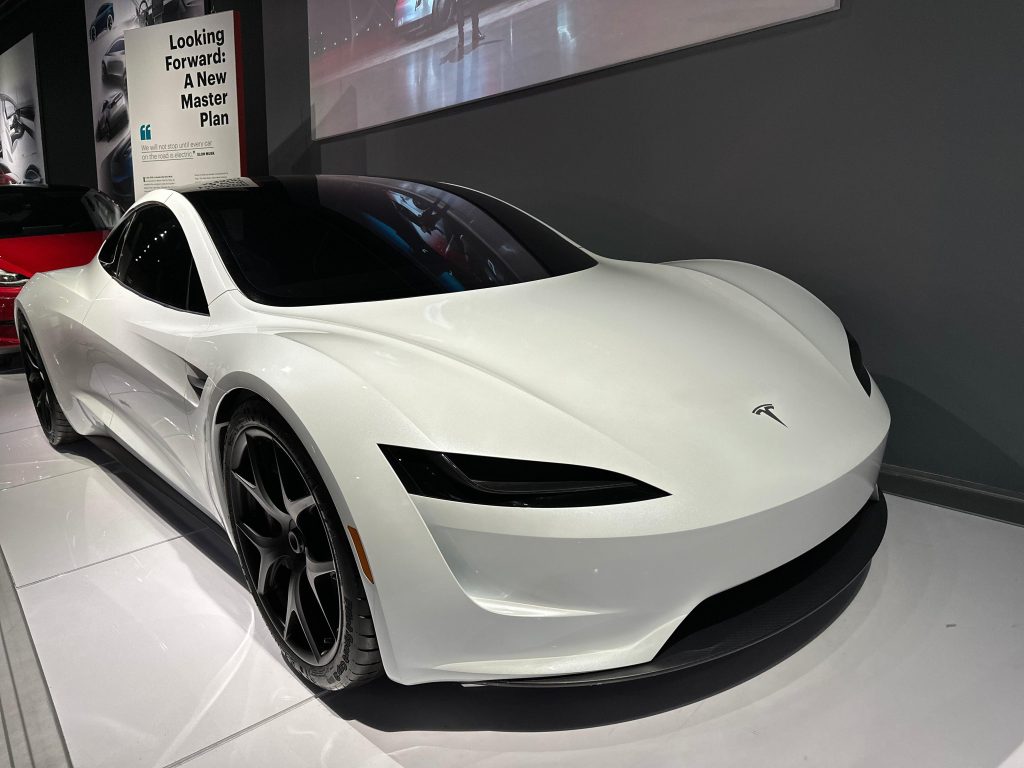
The Supercar That Promised to Break the Rules of the Road
For more than a century, car designers have dreamed of the same impossible thing: a vehicle that does not merely drive fast, but escapes the road altogether. The idea has appeared in cartoons, science-fiction films and failed start-ups since the 1910s. Most of those attempts ended the same way, as expensive curiosities that were too heavy to be good aircraft and too fragile to be good cars.
Then Tesla entered the conversation. The company that made electric cars mainstream, and its CEO Elon Musk, have spent nearly a decade teasing a second-generation Roadster that would not only be the fastest production car ever built, but would also carry an optional “SpaceX package” of cold-gas thrusters. The promise was bold: shorter acceleration times, shorter braking distances, tighter cornering and, perhaps, the ability to hover or make short hops. That is the idea behind what enthusiasts now call the Tesla Roadster Flying Concept.
In October 2026 the story finally moved from teaser posts to a livestreamed demonstration at a SpaceX test facility in Texas. According to multiple reports, Musk declared during the event that flying cars are real, while also acknowledging that success was not guaranteed. The reaction was exactly what you would expect: awe from fans, skepticism from engineers, and a great deal of confusion about what had actually been shown.
In this detailed guide, we separate the spectacle from the engineering. We will look at the history of the project, the claimed performance figures, how cold-gas thrusters actually work, what a hover would physically require, the regulatory wall such a car would hit, and what all of this means for the future of supercars. If you want an honest, in-depth look at the Tesla Roadster Flying Concept, read on.
A note on sources: this project has changed dates and details many times, and reports about the demo differ in places. Figures below are described as claimed or reported unless they come from Tesla directly, and the physics sections are our own simplified estimates, not Tesla data.
A Long Road to the Sky: The History of the Roadster Promise
The 2017 unveiling
The next-generation Roadster was first shown in November 2017, at the same event where Tesla introduced its Semi truck. The headline numbers were designed to sound absurd: 0 to 60 mph in 1.9 seconds, a top speed above 250 mph, and a range of around 620 miles on a single charge. A base price of roughly $200,000 was announced, and early reservations required deposits that reached $250,000 for the Founders Series.
At the time, those numbers would have crushed every production car on the market. Even today, with electric hypercars from several brands pushing the limits of acceleration, the claimed Roadster figures still look extreme, and that is part of the reason skeptics have remained skeptical for so long.
The SpaceX option package
The flying element arrived shortly afterwards. In 2018, Musk described an optional SpaceX package for the Roadster built around roughly ten small rocket thrusters integrated into the car’s body. The idea was not to turn the Roadster into a helicopter. Instead, the thrusters would provide short bursts of force in any direction, improving acceleration, braking and cornering beyond what tyre grip alone allows.
Musk also teased that the package might allow short hops, writing that it was certainly possible and just a question of safety. That comment lit the fuse for years of speculation. It is also worth noting how carefully worded it was: “short hops,” not sustained flight, and “safety” as the main obstacle.
The Starman connection
There is a poetic detail behind the whole story. In February 2018, SpaceX launched Musk’s own original Tesla Roadster into space aboard the first Falcon Heavy, with a mannequin nicknamed Starman at the wheel. That car, powered by a rocket burning liquid propellants, has orbited the Sun ever since. The new Roadster concept brings the relationship full circle: a Tesla with rocket technology, but this time meant to stay close to the ground.
Years of delays
The Roadster has become one of the most delayed products in automotive history. Original production dates in the early 2020s slipped repeatedly. Reveal dates were promised for the end of 2025, then spring 2026, then later in 2026, with production targets that moved to 2027 and then, according to reports from the October 2026 event, to 2028. Some commentators joked that the car should be renamed “next month.” That history matters, because it frames how the public interprets every new claim. Reservation holders have waited for years, and the demonstration was as much about restoring credibility as about showing off hardware.
The Numbers: What Tesla Claims the Roadster Can Do
Before discussing the flying side, it helps to lay out what the base car is supposed to deliver. These are manufacturer or CEO claims, not independently verified results.
| Specification | Claimed figure |
|---|---|
| 0–60 mph (base) | About 1.9 seconds |
| 0–60 mph (with SpaceX package) | About 1.1 seconds (Musk’s claim) |
| Top speed | More than 250 mph |
| Range | Around 620 miles |
| Drivetrain | Tri-motor electric, all-wheel drive |
| Seating | 2+2 |
| Roof | Removable glass roof |
Two points deserve emphasis. First, a 1.1-second 0–60 time is faster than a normal car can achieve through tyres alone, because there is a physical limit to how much grip rubber can generate. Pushing past that limit requires an external force, which is exactly the role the thrusters would play. Second, the SpaceX version reportedly differs from the standard car in more than just hardware: reports from the demo describe a single-driver layout in the thruster-equipped version, which would make it very different from the practical 2+2 grand tourer first announced.
What Is the SpaceX Package? Understanding Cold-Gas Thrusters
Not a jet engine, not a rocket
The phrase “rocket-powered car” is misleading. A conventional rocket burns fuel and oxidizer to create extremely hot, fast exhaust. The Roadster’s thrusters are reported to use compressed air instead, in what engineers call a cold-gas thruster. There is no combustion. A tank stores high-pressure gas, a valve opens, and the gas expands through a nozzle, producing thrust by Newton’s third law: the gas goes one way, the car goes the other.
Cold-gas thrusters are not exotic. They have been used for decades on spacecraft for attitude control, the small, precise adjustments that point a satellite or keep a capsule stable. SpaceX uses the same general category of hardware on its Falcon 9 boosters to steer them during descent and landing. What is new is the idea of scaling this technology to lift or throw a two-ton road car.
The big trade-off: efficiency
Cold-gas systems are simple, reliable and instantly responsive. They are also very inefficient. The key measure is specific impulse, which describes how much thrust you get per unit of propellant per second. Chemical rockets achieve hundreds of seconds. Cold air achieves only around 50 to 70 seconds. In plain terms, you burn through your “fuel” very quickly.
That inefficiency is the central constraint of the whole project. A cold-gas system can deliver huge force for a very short time. It cannot deliver modest force for a long time. That is why the correct mental model is not a flying car cruising over traffic, but a car that can generate spectacular bursts, like a stunt.
Where the thrusters go
Reports describe about ten thrusters distributed around the body. Distributing them matters for control: you need nozzles pointing in several directions to produce forward thrust, braking thrust, lateral force for cornering and vertical lift. For a hover, thrusters under the car would need to push down evenly while others fine-tune pitch and roll, a control problem very similar to that of a drone.
The Physics: Could a Roadster Hover? A Back-of-the-Envelope Look
This section is our own simplified estimate, meant to help readers understand the scale of the challenge. It is not Tesla data.
Step 1: How much force is needed?
Suppose the demo vehicle has a mass of about 2,000 kg, a reasonable guess for a performance electric car with batteries and thrusters. To hover, the thrusters must produce an upward force equal to its weight:
- Weight ≈ 2,000 kg × 9.81 m/s² ≈ 19,600 newtons.
That is roughly 2 tonnes of continuous thrust, far more than any small drone produces.
Step 2: How much gas does that burn?
Propellant mass flow equals thrust divided by (specific impulse × gravitational acceleration). Using an optimistic 60 seconds for cold air:
- Mass flow ≈ 19,600 ÷ (60 × 9.81) ≈ 33 kg of air per second.
Step 3: How long can it last?
One report on the demo describes roughly 250 kg of compressed air stored in two large tanks. At about 33 kg per second:
- Hover time ≈ 250 ÷ 33 ≈ 7 to 8 seconds, in an ideal case with no losses and no additional manoeuvres.
This simple estimate lines up with what observers described: short, dramatic bursts rather than sustained flight. It also shows why “flying car” is an exaggeration as a technical description, even if it is a perfect marketing phrase. Eight seconds of controlled hovering is a remarkable engineering stunt. It is not transportation.
What would it take to do better?
There are only a handful of ways to improve the equation. You can carry more gas, which adds weight and requires more thrust to lift it. You can raise the gas temperature or pressure, which improves efficiency but moves the system away from “cold” and toward more complex, more dangerous hardware. Or you can reduce the vehicle’s weight, which is difficult for a battery-electric car. Every improvement fights the others, which is why sustained flight with this approach remains very unlikely.
The 2026 McGregor Demo: What Actually Happened
The setting
The long-awaited demonstration took place at SpaceX’s McGregor test facility near Waco, Texas. The site is a natural choice: it is where SpaceX tests engines, far from residential areas, with plenty of space for loud and unpredictable hardware. Reports leading up to the event said the demo car would likely be controlled remotely because the noise from the thrusters could be harmful to hearing, with spectators kept a safe distance away.
The date confusion
The event’s date moved repeatedly. Musk first promised a demo for the end of 2025, then April 2026, then later dates, with an October 1 target discussed in some reports. Coverage of the actual livestream points to Thursday, October 15, 2026. If you are researching this topic, it is wise to check the date and details against several outlets, because early reports on the plans contradicted each other.
What viewers saw
According to coverage of the livestream, the vehicle performed aerial manoeuvres using the thruster package, including a flip-and-land sequence while unoccupied. One report described the car leaving the ground for a few seconds on a test ramp. Musk called the machine a flying car during the event, but acknowledged that the project’s success was not guaranteed. Earlier, he had said the demo needed a live audience to vouch that it was not AI-generated, a comment that reflects how much digital skepticism now surrounds any spectacular video.
Production plans after the demo
Musk indicated that production of the new Roadster is expected to begin in 2028. Earlier reporting suggested Tesla might sell a limited-edition SpaceX version alongside a separate, scaled-down variant, with pricing potentially in the hundreds of thousands of dollars or more. These are plans, not commitments, and the history of this project suggests treating every date with caution.
Does It Actually Fly? Hovering, Hopping and Real Flight
The most important question around the Tesla Roadster Flying Concept is also the most definitional. What do we mean by “flying”?
Ballistic hops
The simplest version of “flying” is a ballistic hop: the thrusters push the car off the ground, it travels through the air, and gravity brings it back down. This is how a long jump works. It is aerial, but it is not controlled flight.
Controlled hovering
Hovering is harder. It requires continuous, precisely balanced thrust and rapid stabilization, much like a rocket landing. SpaceX has real expertise here, which is why the partnership is credible. Former Tesla president Jon McNeill said hovering was plausible, though he would not commit to it for the demo.
Sustained flight
Sustained flight, meaning travel through the air over distance with controlled altitude, is something else entirely. Aircraft achieve it with wings or rotors that generate lift efficiently over long periods. A car with cold-gas thrusters has neither. Our estimate above suggests that the energy budget simply does not support it.
The honest label
So is the Roadster a “flying car”? In the poetic sense, yes: it can leave the ground under its own power and move through the air. In the regulatory and engineering sense, no. It is not an aircraft, it would not operate in controlled airspace, and it would not replace a plane or a helicopter. The best description is perhaps “the world’s first thruster-assisted road car,” which sounds less dramatic but is probably closer to the truth.
Engineering Challenges Nobody Can Ignore
Storing the gas
High-pressure tanks are heavy and dangerous. A tank holding hundreds of kilograms of air at very high pressure carries stored energy equivalent to a significant explosive charge if it ruptures. Aerospace tanks use expensive composite materials and strict inspection regimes. Putting them into a road car that can be involved in collisions is a safety problem of an entirely different order than a normal fuel tank.
Control and stability
A car that lifts off needs to control six degrees of freedom: forward, sideways, up, and rotation around three axes. Wind, uneven thrust and sensor errors can all send it tumbling. Drones solve this with fast computing and many small, quick-reacting motors. A heavy car with a few large thrusters has far less margin for error.
Noise and heat
Cold-gas thrusters produce an enormous blast of expanding air, loud enough, according to reports, that spectators must stay hundreds of yards back. The exhaust also kicks up debris. That alone rules out use in any normal public setting.
The driver
As of the October 2026 demo, the flip-and-land sequence was performed without a person inside. Making the same manoeuvre safe for an occupant means dealing with forces, noise and failure modes that a stunt car without a driver never has to consider. If the production version carries a single seat, as reports suggest, that is a sign Tesla is designing around those constraints.
Reusability
A thruster system that can be used once at a test site is very different from one that can be used repeatedly, refilled quickly, inspected and certified. For customers, refilling hundreds of kilograms of compressed air is a logistical question as much as a technical one.
The Regulatory Wall: Roads, Airspace and Insurance
Even if the engineering works, the legal framework might be the harder barrier.
Road regulations
In the United States, cars must comply with Federal Motor Vehicle Safety Standards and be approved for sale. Reports note that the thruster-equipped version would not meet standard automotive safety rules for civilian streets, which is why it was described as a track or special-use machine. The demo vehicle itself was described as not street legal.
Aviation rules
The Federal Aviation Administration regulates anything that flies. Reports at the time of the demo say there was no confirmed FAA approval for the thruster system. If a customer vehicle were able to leave the ground in a meaningful way, it could raise questions about certification, operator licensing and where it may be used. For comparison, true electric aircraft from companies such as Joby and Archer have spent years and large budgets working through certification.
Insurance and liability
Insurers price risk using decades of data. A road car that can fire compressed-air thrusters and briefly become airborne has no such data. Expect any customer version, if it ever exists, to be limited to private property or closed tracks with strict operating conditions.
Price, Production and the Reservation Question
The original Roadster reservations were substantial: deposits ran into the tens of thousands of dollars for the standard car and up to $250,000 for the Founders Series. Those customers have waited many years, and some commentators have called the delay one of the longest in modern car history.
According to reports, Tesla plans a limited-edition SpaceX version with the thruster package and a separate, scaled-down variant. Pricing for the thruster car could reach hundreds of thousands or even millions of dollars. With production now pointed at 2028, the sensible stance for any buyer or enthusiast is patience combined with skepticism. Tesla has a record of delivering ambitious products eventually, but also of missing announced dates by years.
How It Compares: The Roadster versus Real Flying Vehicles
What separates the Roadster from the flying-car companies that are actually pursuing certified aircraft?
- Electric vertical take-off and landing (eVTOL) aircraft such as those from Joby, Archer and others use multiple rotors to lift efficiently and can fly for many minutes over many miles. They are designed from the start as aircraft and are going through formal certification.
- Roadable aircraft and flying-car start-ups have shown prototypes that drive on roads and take off with rotors or wings. They are heavier on paperwork and engineering, but closer to real flight.
- The Tesla Roadster is the opposite approach: a road car first, with a short-lived aerial capability bolted on. It will never be as efficient as a rotor-based vehicle, but it can do things no aircraft does, such as flipping and landing on its wheels.
This difference explains why aviation experts often treat the Roadster as a performance feature or marketing event, not as a step towards urban air mobility. It is also why many car enthusiasts find it exciting: it is the first time a mainstream manufacturer has openly proposed using spacecraft technology purely for driving thrills.
Believers and Skeptics: Two Ways to Read the Demo
The believer’s argument
Supporters point out that SpaceX has landed orbital rockets on drone ships and returned them to their launch pads. If any organization can control a cold-gas hover, it is this one. They also note that the demonstration, whatever its limits, put real hardware in front of a live audience, which is more than most concepts ever do. And they argue that even a limited package could change what a performance car can do around a track, shortening braking zones and boosting acceleration beyond tyre grip.
The skeptic’s argument
Critics respond that the Roadster has been announced for nine years, and that each deadline has slipped. They highlight that the stunt car was unoccupied, remotely operated and not street legal. They point out that the physics limits flight to seconds, that the regulatory path is unclear, and that the “flying car” phrase promises something the system cannot deliver. Some investors read the event as a publicity move aimed at renewing enthusiasm around Tesla’s story, much like the Cybertruck window demonstration did years earlier.
A balanced conclusion
Both camps are partly right. The demo was real and technically impressive. It was also carefully staged. The truth probably lies in the middle: a spectacular, expensive, low-volume halo car with a thruster option that works in a narrow set of conditions.
What It Means for the Future of Supercars
Even if the Tesla Roadster Flying Concept never reaches customers in its current form, it has already changed the conversation about what supercars are for.
The end of the horsepower race
Electric motors have made huge acceleration numbers almost routine. Once every top car does 0–60 in under two seconds, the competition has to move somewhere else. Aerodynamic downforce, active suspension and now thrust vectoring are all candidates. A thruster-assisted car is the most extreme example of this shift.
Technology transfer from aerospace
Supercars have always borrowed from racing and aviation, from carbon-fibre monocoques to active aerodynamics. Using spacecraft attitude-control technology is a natural, if dramatic, extension. Even if cold-gas thrusters never become common, the lessons about fast control systems and lightweight pressure vessels could inform future designs.
Halo effect
Halo cars exist to create desire and to showcase a brand’s ambitions, not to sell in volume. In that sense, the Roadster has already succeeded: millions of people who would not normally follow a supercar launch watched the livestream. For a website like ours, dedicated to cars and the stories behind them, that attention is a reminder of how powerful a single bold idea can be.
Frequently Asked Questions
Can the Tesla Roadster really fly?
It can leave the ground using compressed-air thrusters, and reports describe short aerial manoeuvres at the October 2026 demo. It cannot sustain flight like an aircraft. Our estimate suggests hover durations of only a few seconds with the reported air supply.
How do the SpaceX thrusters work?
They are cold-gas thrusters: high-pressure compressed air is released through nozzles, creating thrust without combustion. This technology is common in spacecraft attitude control.
How fast is the Tesla Roadster?
Tesla claims 0–60 mph in about 1.9 seconds for the base car, a top speed above 250 mph, and about 620 miles of range. Musk has claimed 1.1 seconds to 60 mph with the SpaceX package. None of these figures have been independently verified.
When will the Roadster be produced?
Musk indicated production would begin in 2028, according to reports of the October 2026 event. Given the project’s history of delays, this date should be considered a target rather than a guarantee.
How much will the SpaceX version cost?
No official price has been confirmed. Reports suggest the limited-edition version could cost hundreds of thousands of dollars or more.
Is the flying Roadster street legal?
The demo vehicle was described as not street legal, and reports say the thruster version would not meet standard civilian road safety rules.
Is this a real flying car like an eVTOL?
No. An eVTOL is an aircraft designed for efficient flight over distance. The Roadster is a road car with a thruster package that offers brief aerial capability.
Conclusion: A Dream Worth Watching, With Both Eyes Open
The Tesla Roadster Flying Concept is one of the strangest and most fascinating projects in the history of the car. It combines the claimed performance of an electric hypercar with technology borrowed from rockets, and it asks us to imagine a future in which a road car can briefly forget the road.
The truth, as best we can tell from the available evidence, is more modest than the slogans and more impressive than the cynics admit. A thruster-equipped Roadster can make dramatic short manoeuvres, but the physics of cold gas, the weight of the car and the limits of regulation keep it far from the flying car of science fiction. What it offers instead is something uniquely automotive: a halo machine, a technology showcase, and a daring statement about how far a manufacturer is willing to go for performance.
Whether production begins in 2028 or slips again, the project has already done what the best concept cars do. It has made people argue, dream and look up. We will continue to follow every update, so stay tuned to worldmotorcars.info for the latest on the Tesla Roadster, supercars and the technology that is reshaping the road.
What do you think: is the flying Roadster a genuine leap forward or an elaborate publicity stunt? Share your opinion in the comments below.