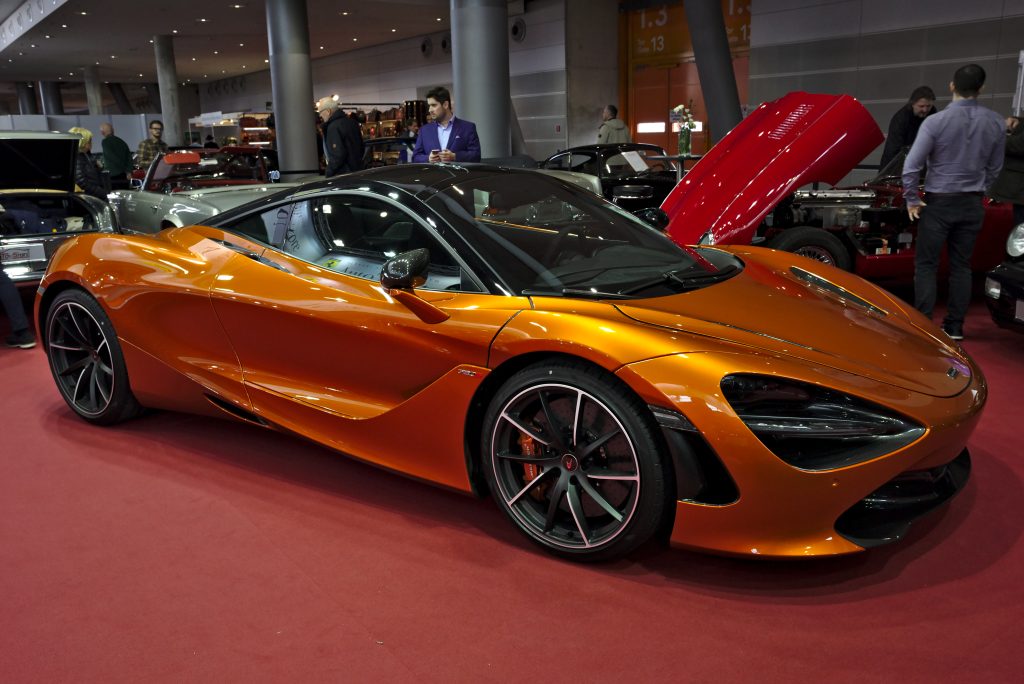
Some cars are fast. Some are beautiful. A very small number manage to change the way an entire segment thinks about what a supercar should be. The McLaren 720S belongs in that last group. When it appeared at the Geneva Motor Show in March 2017, it did not simply replace the McLaren 650S; it rewrote the rulebook for mid-engined performance cars. It was lighter than most of its rivals, quicker in a straight line than machines costing far more, and it was wrapped in a body that looked like it had been shaped by wind rather than by a conventional design studio.
More than half a decade after its debut, the McLaren 720S remains one of the most compelling supercars you can buy, new or used. It combines hypercar-level acceleration with a level of steering feel and chassis composure that few competitors have matched. It also happens to be surprisingly usable: the ride is supple, the visibility is excellent for a car in this class, and the dihedral doors make getting in and out feel like part of the theater.
In this complete guide, we go deep into everything that makes the McLaren 720S special. We cover its history, its design philosophy, its carbon fiber structure, its twin-turbocharged V8 engine, its clever hydraulic suspension, its interior technology and its driving experience. We also compare it with its main rivals, look at the Spider and the track-focused variants, and finish with a practical buyer’s guide for anyone thinking about putting one in their garage.
A Quick Overview of the McLaren 720S
Before we dive into the details, here are the headline figures that define the car:
- Engine: 4.0-liter twin-turbocharged V8 (M840T)
- Power: 720 PS (710 hp) at 7,500 rpm
- Torque: 770 Nm (568 lb-ft) from 5,500 rpm
- Transmission: 7-speed Seamless Shift dual-clutch gearbox (SSG)
- Drive: Rear-wheel drive
- 0-100 km/h (0-62 mph): 2.9 seconds
- 0-200 km/h (0-124 mph): 7.8 seconds
- Quarter mile: approximately 10.3 seconds
- Top speed: 341 km/h (212 mph)
- Dry weight: 1,283 kg (2,829 lb)
- Structure: Carbon fiber MonoCage II monocoque
- Production years: 2017 to 2023 (succeeded by the 750S)
Those numbers tell part of the story, but they do not explain why so many drivers and journalists describe the 720S as one of the best supercars of its generation. To understand that, we need to look at where it came from.
The History Behind the McLaren 720S
McLaren Automotive’s Road to the 720S
McLaren’s road car story did not begin with the 720S. The company had already built legends: the McLaren F1 of the 1990s, widely regarded as one of the greatest cars ever made, and the Mercedes-Benz SLR McLaren of the 2000s. But McLaren Automotive, the modern company responsible for the 720S, was formally established in 2010, and its first car, the MP4-12C, arrived in 2011.
The 12C was an engineering triumph in many ways. It introduced McLaren’s carbon fiber MonoCell tub to a wider audience, a clever hydraulic suspension system that did away with traditional anti-roll bars, and a new twin-turbo V8 engine. However, critics felt it lacked some of the drama and emotional punch of rivals from Ferrari and Lamborghini. The styling was clean but conservative, and the interior was functional rather than special.
McLaren listened. The 650S, launched in 2014, was a heavy revision of the 12C with sharper looks, more power and better tuning. It was followed by the 675LT, a hard-edged, track-focused special that proved McLaren could build cars with real character. By the time the company began work on the next generation, it knew it had the engineering foundation to leap ahead of the competition.
The Birth of the Super Series
The 720S was the first car in what McLaren calls its Super Series, the middle tier of its three-part range alongside the entry-level Sports Series and the flagship Ultimate Series. It was the first McLaren designed from the start under the company’s ambitious Track25 business plan, which aimed to launch 18 new cars or derivatives by 2025.
The brief for the 720S engineers was deceptively simple: build a car that was lighter, stiffer, more powerful, more aerodynamic and more usable than the 650S. In practice that meant a nearly clean-sheet approach. McLaren has stated that a very large share of the car’s components were new. The carbon fiber structure was redesigned, the engine was extensively reworked, the suspension was reengineered, and the design language was thrown out and started afresh.
Launch and Reception
The car was revealed in Geneva in March 2017 and customer deliveries began in the middle of that year. The reaction was immediate. Journalists who attended the first drives wrote about steering that felt like a revelation, an engine that pulled with ferocious urgency, and a ride quality that seemed to defy the car’s performance potential. In independent testing, the 720S frequently outran cars with significantly more power on paper, including some hypercars from rival brands.
At launch in the United States, pricing started at roughly $285,000, and in the United Kingdom at around £208,000, before options. That put it squarely against the Ferrari 488 GTB, the Lamborghini Huracán Performante and, at the top end, the Porsche 911 GT2 RS. In most comparisons, the McLaren held its own and often came out ahead.
Design: A Supercar Shaped by the Wind
The Inspiration: A Shark and a Fighter Jet
McLaren’s design team, led by Rob Melville, took inspiration from the natural world and from aviation. The official narrative describes the shape as derived from the form of a manta ray or a shark moving through water, and from the contours of a jet fighter canopy. Whatever the source, the result is a body that looks organic and tight-fitted, with very few straight lines and none of the aggressive creases that dominate many modern supercars.
The most striking feature at the front is the pair of headlights. McLaren calls them eye sockets: deep recesses that house the lighting units and also serve a functional purpose, because they feed air through the bodywork to the radiators. This is a recurring theme with the 720S. Almost every visual element does a job.
The Double-Skin Dihedral Doors
The doors are perhaps the most memorable design element. They swing up and forward in the manner McLaren has used since the F1, and they open higher than the hinge line to make entry easier. Unlike on previous models, the 720S door is a double-skin design with a hollow channel that carries air from the front fender to the rear of the car. Air that would otherwise create turbulence along the sides is guided into the radiators and around the body.
The doors also gain a practical benefit: the leading edge of the sill is dropped and the glazed section of the door extends into the roof. The result is that you can look up through the glass above you and see the sky, and getting into the car is easier than on most low-slung supercars. The roofline itself is slender, and the glass area is generous, giving the 720S some of the best outward visibility in its class.
Aerodynamics That Work Without Shouting
Most supercars use visible wings, splitters and vents to generate downforce. The 720S generates a great deal of aerodynamic grip, but it does so with a cleaner and more integrated approach. The front splitter, the flat underbody, the rear diffuser and the sculpted rear deck all work together to create stable pressure on the car at speed.
At the back, an active rear wing rises and tilts according to speed and driving mode. When you brake hard from high speed, the wing lifts to a steep angle and acts as an air brake, adding drag and shifting weight forward to improve stopping performance. McLaren has stated that this system helps the 720S stop in very short distances from three-digit speeds, and it also delivers up to 30 percent more downforce than the 650S’s wing in some configurations.
Because the car feels so planted at high speed, drivers can exploit more of its capability with confidence. That is exactly what aerodynamic design should achieve: not just a larger number on a data sheet, but more usable performance on a real road or racetrack.
Lightweight by Obsession
McLaren’s engineers focused heavily on mass. Even the exhaust system uses thin-walled materials, and many body panels are made from aluminum rather than steel. The front and rear body sections are formed from superplastically formed aluminum, a process that allows complex curves with minimal weight. The result is a car that tips the scales at 1,283 kg dry, and around 1,419 kg with fluids and a full tank under DIN standards. Competitors such as the Ferrari 488 GTB and Lamborghini Huracán are comfortably heavier.
The Carbon Fiber Heart: MonoCage II
Every McLaren since the 12C has been built around a carbon fiber tub, and the 720S takes the idea to a new level with the MonoCage II. A monocoque this rigid and light is typically the preserve of racing cars and six-figure hypercars. In the 720S it is the starting point for the entire vehicle.
The MonoCage II is stiffer than the structure it replaced, while being lighter. It also incorporates a section of the roof structure into the carbon fiber cell, which enhances torsional rigidity and allows for thinner roof pillars. That is part of the secret behind the car’s excellent visibility.
A stiff structure does more than protect occupants in a crash. It lets the suspension work precisely, because the tub does not flex under load. It improves steering response because forces are transmitted directly instead of being absorbed by the chassis. And it reduces noise, vibration and harshness, which is why the 720S feels solid and refined despite being so focused.
Carbon fiber is also very costly and complex to manufacture. McLaren produces its tubs at the McLaren Composites Technology Centre in Sheffield, England, a facility that was built specifically for this purpose. Each tub is made from layers of carbon fiber that are carefully cut, laid and cured in an autoclave. This capability is one of the main reasons the 720S can deliver an exotic construction at a price that undercuts some of its rivals.
The Engine: The 4.0-Liter M840T Twin-Turbo V8
Evolution of a Proven Design
The 720S uses the M840T, a 4.0-liter twin-turbocharged V8 engine that is an evolution of the unit found in previous McLaren models. While it shares its basic architecture with earlier versions, McLaren has stated that a large percentage of its internal components are new. The goal was to add power, improve response and reduce weight.
The numbers are substantial: 720 PS (710 hp) at 7,500 rpm and 770 Nm (568 lb-ft) of torque from 5,500 rpm. The engine has a flat-plane crankshaft, a dry-sump lubrication system and a redline of 8,000 rpm. The dry sump allows the engine to sit lower in the chassis and ensures consistent oil supply under extreme lateral loads, an important feature for track driving.
Turbochargers and Response
Turbo lag has long been the enemy of forced-induction performance cars. McLaren tackled it in the 720S with new, lighter turbochargers that use electronic wastegates and low-inertia turbine wheels. The result is a response that feels almost naturally aspirated when you press the throttle. Even at lower revs, the engine pulls cleanly, and there is a very short delay before the boost builds.
At full power, the turbos deliver a relentless surge of acceleration that builds all the way to the redline. Drivers frequently describe the sensation as being fired out of a cannon. Because the 720S is rear-wheel drive and the power delivery is so strong, you feel the rear tires working hard, even in higher gears. It is a thrilling experience, and a rare case where the numbers on the page genuinely underplay what the car feels like.
Sound and Character
Here the 720S divides opinion. The twin-turbo V8 does not sing like a naturally aspirated Ferrari V8 or bellow like a Lamborghini V10. Instead it has a deep, hard-edged, almost industrial growl that builds with revs and crackles on overrun. In Sport and Track modes the exhaust valves open more, and the sound becomes more aggressive. Some purists wish for a higher-pitched wail, but many owners love the muscular, mechanical character that fits the car’s focused personality.
Efficiency and Emissions
Performance cars of this level are not known for economy, but the 720S does include features that help in everyday driving. It has stop-start technology, a ratio-optimized gearbox for relaxed cruising, and cylinder-specific fueling control. Official combined fuel consumption is around 10.7 liters per 100 km (roughly 22 mpg US) in European testing, though real-world figures vary widely depending on how you drive. Push the car hard and you will see numbers considerably worse than that.
Transmission and Drivetrain
Power reaches the rear wheels through a seven-speed Seamless Shift Gearbox (SSG), a dual-clutch automatic. It is quick, smooth and intelligent. In normal mode it shifts almost imperceptibly, making it surprisingly easy to drive around town. In Sport and Track modes, it shifts more quickly and with a sharper feel, and it holds gears for maximum performance.
The car has two sets of controls for driving character, which McLaren separates into Powertrain and Handling. The Powertrain selector adjusts the engine, gearbox and exhaust behavior, while the Handling selector changes the suspension and stability control settings. Each has Comfort, Sport and Track settings. This gives the driver a huge range of combinations. You can, for example, run the engine and gearbox in Track mode while keeping the suspension in Comfort for a bumpy road.
The 720S is rear-wheel drive only. Unlike the Lamborghini Huracán and Audi R8, it does not have an all-wheel-drive system. That contributes to its purity and also to its lightness. It does mean you need to treat the throttle with respect in wet or cold conditions, though modern stability control and Variable Drift Control keep things manageable for most drivers.
Launch Control
For maximum acceleration, the 720S has a Launch Control function. Select the right modes, hold the brake and the throttle, and release the brake, and the car launches with precisely controlled wheelspin. The result is a 0-100 km/h time of 2.9 seconds, and in real-world conditions testers have often recorded times even quicker than that. Independent tests have shown the 720S reaching 0-200 km/h in under 8 seconds, a figure that places it in hypercar territory.
Performance: Numbers That Challenge Hypercars
The 720S is, by any objective measure, extremely fast. Let’s look at what that means in practice.
Straight-Line Acceleration
According to McLaren, the 720S sprints from 0-100 km/h (62 mph) in 2.9 seconds, reaches 200 km/h (124 mph) in 7.8 seconds, and covers the standing quarter mile in about 10.3 seconds. Independent testers regularly record better results, in part because McLaren’s official figures are considered conservative. In certain tests, the car has reached 60 mph in under 2.8 seconds and covered the quarter mile in the 10-second range at more than 135 mph.
The top speed is 341 km/h (212 mph), which puts it in a rarefied club of production cars. It has been compared against much more powerful hypercars in drag races, and it has often won, particularly when conditions favored traction and gearbox efficiency.
Braking Performance
Acceleration is only half the story. The 720S has carbon ceramic brakes as standard, along with that active rear wing that doubles as an air brake. McLaren states that the car can stop from 100 km/h in about 30 meters and from 200 km/h to a standstill in around 117 meters. In practice, the pedal feel is strong and progressive, and the brakes resist fade even after repeated hard stops on track.
Lateral Grip and Handling
The 720S rides on Pirelli P Zero tires, with an optional P Zero Corsa upgrade for drivers who plan to use the car on circuit. Wheels measure 19 inches at the front and 20 inches at the rear. The combination of light weight, stiff structure, aerodynamic downforce and a clever suspension gives the car extraordinary cornering ability, with grip levels that approach those of dedicated race cars on the right surface.
What makes the 720S exceptional, though, is how approachable that grip feels. The car communicates clearly when you are near the limit, and it tends to progress gently rather than snap. That is not an accident. McLaren engineers spent a long time tuning the car so that skilled drivers can enjoy its capability, and less experienced drivers can still have fun without feeling like they are about to lose control.
Suspension: Proactive Chassis Control II
If there is one piece of technology that defines the character of a modern McLaren, it is the hydraulic suspension. In the 720S, it is called Proactive Chassis Control II, or PCC II.
Traditional suspension uses springs, dampers and anti-roll bars at each end of the car. When you turn, the anti-roll bars limit body roll, but they also compromise ride comfort because they link the left and right wheels. McLaren’s system takes a different approach. Each damper is connected hydraulically to the others diagonally and across the car by a network of fluid lines and a central accumulator. The system controls roll and pitch without anti-roll bars, which means the car can have a soft, supple ride without wallowing in corners.
In the 720S, the system has been refined with a new, faster-reacting accumulator and a more sophisticated control strategy. The result is a car that rides over rough roads better than many luxury sedans yet corners almost flat. Mid-corner bumps barely upset the car, and the tires stay in contact with the surface. It is one of the main reasons the 720S is so comfortable on a long journey and so confident on a racetrack.
The Comfort mode is soft enough that you can commute in it. Sport tightens the car’s body control, and Track mode makes it uncompromisingly firm while retaining remarkable compliance. In every setting, the system keeps the car stable and composed, and it contributes heavily to the driver’s confidence.
Steering That Others Envy
In an age of electric power steering, the 720S has a hydraulic steering rack. This is a deliberate choice, and it is one of the car’s greatest assets. The steering is light at low speeds, becomes naturally weighted as speed increases, and transmits detailed information about the road surface and the front tires’ grip levels. Many reviewers have called it the best steering of any modern supercar.
This is a big part of why the car feels so intuitive. You do not need to guess how much grip the front axle has; the steering tells you. It makes fast driving feel natural and engaging, and it gives the 720S a sense of connection that is rare in modern performance cars.
Interior and Technology: A Cockpit Built Around the Driver
Minimalist, Focused and Refined
Step inside a 720S and the first impression is of space and light. The thin roof pillars, the glazed upper sections of the doors and the low dashboard create a bright, airy cabin that feels far less claustrophobic than most mid-engined cars. The seating position is low, the steering wheel is free of buttons and the controls are arranged logically, so the driver is never overwhelmed.
Materials are of high quality. Leather and Alcantara cover most surfaces, there is exposed carbon fiber on the center tunnel and the sills, and the switchgear has a satisfying, precise feel. Buyers could choose from several interior themes, and McLaren Special Operations (MSO) offered more elaborate customization for those who wanted something unique. While the cabin is not as lavish as those of some Italian rivals, it has a clean and purposeful elegance that suits the car perfectly.
The Folding Driver Display
One of the most talked-about features is the folding instrument cluster. In normal driving, the digital display shows speed, rpm and navigation information in a conventional layout. But press a button on the dashboard, and the screen folds down into a slim strip that shows only essential data: gear, speed and a shift light bar. It is a clever solution for track driving, where you want fewer distractions and a clearer view of the road ahead.
The idea is typically McLaren: take a feature that most manufacturers would treat as a simple screen and turn it into something that reflects the car’s mission. It also looks fantastic, and it has become one of the car’s signature elements.
Infotainment and Connectivity
In the center of the dashboard is a vertically oriented touchscreen running the McLaren Infotainment System II. It handles navigation, audio, vehicle settings and smartphone connectivity. Early versions of the system drew some criticism for slow response, but later software updates improved performance, and the interface is generally intuitive. Apple CarPlay was added on later cars, and an optional Bowers & Wilkins audio system provided excellent sound for those who wanted to enjoy music in addition to the engine.
The car also supports McLaren Track Telemetry (MTT), a data-logging system that records speed, lap times, braking, steering and throttle inputs, and even video from a dashboard-mounted camera. Drivers can review their performance after a track session and learn where to improve. For enthusiasts who enjoy driving circuits, it is a powerful feature that turns the car into a driving school.
Practicality: A Supercar You Can Live With
The 720S is surprisingly practical for its category. There is a front luggage compartment that holds around 150 liters, enough for a couple of soft bags or weekend luggage, and a small shelf behind the seats for additional items. The ride in Comfort mode is genuinely pleasant, the car has a nose-lift system to clear steep driveways and speed bumps, and the visibility makes parking and maneuvering relatively easy.
Of course, it is still a low-slung supercar. Getting in and out requires some technique, the cabin is narrow at the sills, and storage for small items is limited. But compared with many rivals, the 720S makes fewer demands on its owner, and that is a significant part of its appeal.
Driving Experience: What It Feels Like on Road and Track
On the Road
In everyday driving, the 720S is remarkably docile. With the Powertrain and Handling selectors in Comfort, the engine is quiet at low rpm, the gearbox shifts smoothly, and the suspension absorbs rough surfaces with ease. You can drive it through city traffic without feeling like you are struggling against the machine. The steering is light, the clutch-free transmission works seamlessly and the air conditioning keeps the cabin comfortable.
Then you open up the throttle on an empty road, and the car transforms. The V8 comes alive, the turbos spool, and the acceleration is savage. Gear changes arrive with a sharp snap, and the car seems to shrink around you as the speed rises. Even at very high speeds, it feels planted and stable, and the steering stays alive in your hands.
On the Track
On a circuit, the 720S reveals its true talent. Switch both selectors to Track mode and the car tightens up, the exhaust opens, and the traction control loosens to let the rear tires work. The chassis is adjustable, balanced and incredibly responsive. You can brake late, turn in sharply, and apply power early on corner exit, with the car always communicating what it is doing.
The Variable Drift Control system, available in Track mode, allows drivers to enjoy controlled slides by letting the stability system permit a chosen angle of oversteer. For less experienced drivers, it makes the car a forgiving platform to explore the limits. For experts, it is a way to push even further without fear.
Lap times at well-known circuits have confirmed that the 720S is among the fastest road-legal cars of its time. At many tracks, it matched or beat cars that cost much more, including limited-production hypercars. That is a testament to the strength of its engineering, not just its horsepower.
The McLaren 720S Spider
In 2019, McLaren introduced the 720S Spider, an open-top version that retained nearly all of the coupe’s performance. It uses a retractable hardtop that folds in about 11 seconds and can operate at speeds up to 50 km/h (31 mph). The roof is made from lightweight materials, and a glass rear window can be raised or lowered independently to let more of the engine sound into the cabin.
Because the carbon fiber structure is so strong, McLaren did not need to add heavy reinforcements for the Spider. The tub is called the MonoCage II-S, and it carries over the rigidity of the coupe’s structure. The weight increase is modest, at around 49 kg, so the performance figures remain almost identical: 0-100 km/h in 2.9 seconds and a top speed of 341 km/h with the roof closed.
The Spider adds a new layer of drama to the driving experience. With the roof down and the window lowered, the induction roar and turbo whistle become far more immediate, and the connection to the environment is intensified. It is a more theatrical version of an already theatrical car, and many buyers consider it the most desirable variant.
Track-Focused Variants and Descendants
McLaren 720S GT3 and GT3X
McLaren built a racing version of the car, the 720S GT3, to replace the 650S GT3. It was introduced in 2019 and went on to compete in endurance racing series around the world. Its development drew on the road car’s strengths, including its stiff monocoque, balanced weight distribution and strong aerodynamic efficiency. In 2021, McLaren revealed the 720S GT3X, a track-only car for private use that was free from the regulations of GT3 racing. It offered more downforce and more power and was aimed at owners who wanted a pure track weapon.
The 765LT
The 720S also provided the foundation for the McLaren 765LT, launched in 2020. LT stands for Longtail, a name that dates back to the 1997 F1 GTR Longtail. The 765LT had 765 PS, a lower weight thanks to extensive use of carbon fiber and titanium, and a more aggressive aerodynamic package. It was limited to 765 units worldwide and is now one of the most sought-after modern McLarens.
The 750S: The Successor
In 2023, McLaren replaced the 720S with the 750S. The newer car has 750 PS, a lower weight and many incremental improvements to its chassis and technology. Yet the 720S remains an excellent choice. Its design is more elegant to many eyes, it is less expensive on the used market, and it still delivers performance that few cars on the road can match.
McLaren 720S vs. Its Rivals
The 720S arrived in a fiercely competitive segment. Here is how it compares with its main rivals.
McLaren 720S vs. Ferrari 488 GTB
The Ferrari 488 GTB has a 3.9-liter twin-turbo V8 producing 670 PS and is also a rear-wheel-drive, mid-engined car. It has a more emotional character and a more sophisticated badge image. Yet in most comparisons, the 720S is faster, lighter and more engaging in its steering. The Ferrari has a stronger brand halo and often holds its value more strongly, but the McLaren delivers more raw performance for the money. The Ferrari’s successor, the F8 Tributo, closed the gap with 720 PS, though the 720S still holds its own in many tests.
McLaren 720S vs. Lamborghini Huracán Performante
The Huracán Performante uses a naturally aspirated 5.2-liter V10 and all-wheel drive. It sounds spectacular and offers great traction, and it set a production-car lap record at the Nürburgring when it was launched. However, it is heavier than the McLaren, and its ride is firmer. The 720S is faster in a straight line, and its hydraulic steering and suspension give it a more natural, fluid feel on the road.
McLaren 720S vs. Porsche 911 GT2 RS
The 911 GT2 RS, with its 700 PS flat-six turbo engine, is a monster of a car, with rear-engine layout and a reputation for being demanding to drive. It is brutally fast and was also a record breaker. The McLaren is more usable, more comfortable and easier to drive quickly, while the Porsche offers a more intense, raw experience for experienced drivers.
McLaren 720S vs. Audi R8 V10 Plus
The R8 is easier to live with and more affordable, but it is also significantly less powerful and less dramatic. It is a superb everyday supercar, but it does not offer the same level of performance or engagement as the 720S.
In short, the McLaren 720S stands out through its blend of speed, steering feel, ride quality and visibility. It may not have the heritage image of Ferrari or the theatrical drama of Lamborghini, but in terms of pure driving ability, it sets the standard.
Ownership: Reliability, Running Costs and Maintenance
Reliability
McLaren’s reputation for reliability has improved considerably since the early days of the 12C. The 720S is generally regarded as a much better car in this regard, with a stronger electrical architecture and more refined software. Nonetheless, it is a complex, high-performance machine, and owners should be prepared for the occasional issue. Common points mentioned by owners include 12-volt battery maintenance (the car can drain its battery if left unused for long periods), infotainment glitches that are often resolved with software updates, and occasional sensor faults.
A battery conditioner or trickle charger is highly recommended for any owner who does not drive the car frequently. It is an inexpensive way to avoid a common annoyance.
Maintenance and Servicing
McLaren recommends annual servicing, and costs vary by region and by the work needed. A minor service is generally far less than a major one, and extended warranties are available from McLaren for those who want peace of mind. Tires and carbon ceramic brakes are the biggest wear items: a set of rear tires can be consumed quickly by spirited driving, and replacing carbon ceramic discs is expensive, although they last a long time under normal road use.
Insurance and Depreciation
Insurance costs depend on your location, driving record and storage arrangements. As with any supercar, expect premiums to be considerably higher than for a standard performance car. Depreciation has been significant on early cars, which is good news for used buyers. Prices of used 720S coupes have fallen well below their original sticker prices, while rare specifications, low-mileage examples and the Spider tend to hold value better.
Buyer’s Guide: What to Check Before You Buy a Used McLaren 720S
If you are planning to buy a pre-owned 720S, a careful approach will pay off. Here are the key points to consider.
- Service history: Insist on a complete record of servicing from McLaren dealers or recognized specialists. A missing history is a red flag.
- Warranty status: Check whether the car remains within the factory warranty or has an approved extended plan. Transferability matters.
- Software updates: Confirm that the car has received all available updates. Newer software improves infotainment performance and fixes known bugs.
- Brakes and tires: Inspect the condition of the carbon ceramic discs and the date codes on the tires. Aged tires should be replaced regardless of tread depth.
- Hydraulic suspension: Look for any leaks and test the ride on varied surfaces. The system should feel smooth and consistent.
- Bodywork and paint: Check for stone chips, especially on the front end, and for signs of repair. Paint protection film is a worthwhile addition.
- Doors and electrics: Operate the dihedral doors several times, check the windows, sensors and electronic features, and ensure there are no warning lights.
- Specification: Options such as the Lift system, the Sport exhaust, carbon fiber packs and the Bowers & Wilkins audio can influence value and enjoyment.
- Pre-purchase inspection: Always arrange an independent inspection by a McLaren specialist. It is a small expense compared with the potential cost of an unexpected repair.
Certified pre-owned programs from McLaren dealers offer additional reassurance, usually including an inspection, a warranty and sometimes a recent service. They cost more up front but can be worth it for first-time McLaren buyers.
Pros and Cons of the McLaren 720S
Pros
- Staggering acceleration and top speed that rival hypercars
- Outstanding hydraulic steering with real feedback
- Supple, comfortable ride thanks to Proactive Chassis Control II
- Lightweight carbon fiber MonoCage II structure
- Excellent visibility and a bright, airy cabin
- Distinctive design with functional aerodynamics
- Strong value compared with some rivals, especially on the used market
Cons
- Engine sound is less melodic than some rivals
- Infotainment on early cars can feel slow
- Occasional electrical or software quirks
- High running costs for tires, brakes and servicing
- Brand cachet and resale strength trail Ferrari in some markets
- Limited storage and demanding entry for tall passengers
Frequently Asked Questions About the McLaren 720S
How fast is the McLaren 720S?
The McLaren 720S accelerates from 0-100 km/h (0-62 mph) in 2.9 seconds, reaches 200 km/h (124 mph) in 7.8 seconds and has a top speed of 341 km/h (212 mph).
How much horsepower does the McLaren 720S have?
It produces 720 PS, which equals 710 horsepower, from a 4.0-liter twin-turbocharged V8 engine, with 770 Nm (568 lb-ft) of torque.
Is the McLaren 720S all-wheel drive?
No. The 720S is rear-wheel drive only, which contributes to its light weight and pure handling character.
How much does a McLaren 720S cost?
At launch, the car started at roughly $285,000 in the United States and £208,000 in the United Kingdom. Used prices vary according to age, mileage, specification and market conditions, so check current listings for up-to-date figures.
What is the difference between the 720S and the 720S Spider?
The Spider has a retractable hardtop and a slightly higher weight, but performance is almost identical to the coupe. It offers an open-air driving experience with the same chassis technology.
Is the McLaren 720S reliable?
It is considered more dependable than earlier McLarens, though it is still a complex supercar. Regular servicing, a battery conditioner and a thorough pre-purchase inspection are the best ways to avoid problems.
Is the McLaren 720S a good first supercar?
Its comfortable ride, great visibility and approachable handling make it one of the easier supercars to live with. However, its performance is enormous, so new owners should take time to learn the car and respect its capabilities.
Final Verdict: Is the McLaren 720S Worth It?
The McLaren 720S is one of those rare cars that lives up to its reputation. It is extraordinarily fast, beautifully engineered and genuinely rewarding to drive. It delivers the sort of performance that once belonged only to limited-edition hypercars, yet it can be driven to the shops, parked easily and enjoyed on a long trip.
Its carbon fiber structure, its hydraulic suspension and its communicative steering represent the best of McLaren’s engineering philosophy: build a car around the driver, remove everything that does not contribute to the experience, and refine what remains to near perfection. Few supercars of its era achieved that so convincingly.
If you are considering a supercar and value driving feel, usability and raw performance above brand prestige, the 720S deserves a place at the top of your list. Whether you choose the coupe or the Spider, buy a clean, well-documented example and look after it, and it will repay you with one of the most exciting automotive experiences available today.
What do you think of the McLaren 720S? Do you own one, or is it your dream car? Share your thoughts in the comments below, and keep following World Motor Cars for more in-depth reviews of the world’s greatest machines.