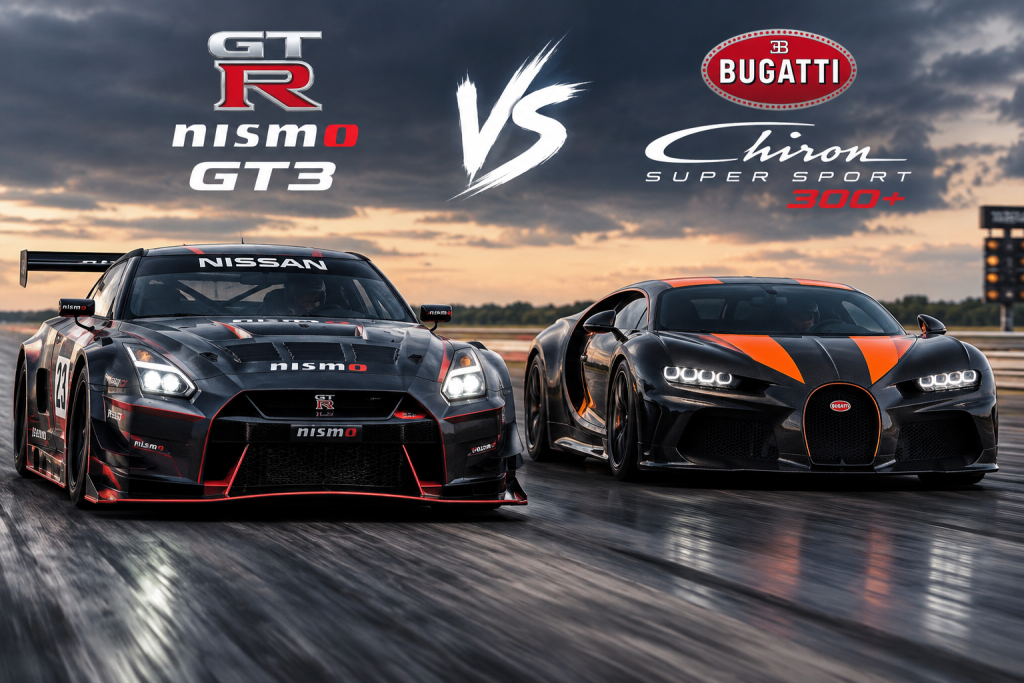
What happens when you compare a purpose-built racing weapon with the fastest road-going hypercar ever created? The Nissan GT-R NISMO GT3 and the Bugatti Chiron Super Sport 300+ are both legends, but they were built for completely different missions. One was engineered to win endurance races. The other was engineered to break the 300 mph barrier.
In this guide, we compare their engines, performance, design, price and real-world purpose to help you understand which one truly comes out on top.
Quick Comparison Table
| Specification | Nissan GT-R NISMO GT3 | Bugatti Chiron Super Sport 300+ |
|---|---|---|
| Engine | 3.8L twin-turbo V6 (VR38) | 8.0L quad-turbo W16 |
| Power | ~500–550 hp (varies with FIA Balance of Performance) | 1,578 hp (1,600 PS) |
| Torque | Race-tuned, approx. 640 Nm | 1,600 Nm |
| Drivetrain | Rear-wheel drive | All-wheel drive |
| Transmission | 6-speed sequential racing gearbox | 7-speed dual-clutch |
| Weight | ~1,300 kg (GT3 regulation minimum) | ~1,995 kg |
| Top speed | Track-dependent (race gearing) | 304.77 mph / 490.48 km/h (record run) |
| Purpose | FIA GT3 racing | Road-legal speed record hypercar |
| Production | Customer racing program | 30 units |
| Price | Roughly US$400,000+ (race car) | Approx. €3.5 million |
Figures for the GT3 vary by season and homologation; always verify against official sources.
Nissan GT-R NISMO GT3: Built to Win Races
The Nissan GT-R NISMO GT3 is the racing evolution of the famous “Godzilla.” Developed by NISMO, Nissan’s performance and motorsport division, it competes in the FIA GT3 category, the world’s most popular customer racing class.
Engine and Powertrain
It uses the 3.8-liter twin-turbocharged V6 from the road GT-R, retuned for endurance racing. Unlike the street car, it is rear-wheel drive and uses a sequential racing gearbox. Power output is adjusted through Balance of Performance (BoP) rules so every GT3 car competes fairly.
Race Pedigree
The GT-R NISMO GT3 has competed in major series and endurance events worldwide, including the Nürburgring 24 Hours and the Bathurst 12 Hour, which it won in 2015. Its strengths are durability, consistency and brutal track performance.
Why It Matters
It proves that a car derived from a road model can compete against Ferrari, Porsche, Lamborghini and Mercedes-AMG at the highest level of GT racing.
Bugatti Chiron Super Sport 300+: The 300 MPH Legend
The Bugatti Chiron Super Sport 300+ is the production tribute to Bugatti’s historic speed run. In September 2019, a prototype driven by Andy Wallace reached 304.773 mph (490.484 km/h) at the Ehra-Lessien test track in Germany, making Bugatti the first to cross 300 mph in a near-production hypercar.
Engine and Powertrain
The 8.0-liter quad-turbocharged W16 engine produces 1,578 hp and 1,600 Nm of torque. It is the most extreme version of the legendary Bugatti W16, designed for stability and power at speeds most cars will never see.
Aerodynamics and Design
The Super Sport 300+ has a stretched rear body (about 25 cm longer) for improved high-speed stability. The “longtail” design reduces drag and gives the car a distinctive silhouette.
Exclusivity
Only 30 customer cars were built, and production speed is electronically limited to 273 mph (440 km/h). The record-run car was a special prototype, which is worth mentioning because the record was set one-way and was not officially ratified by Guinness.
Head-to-Head: Which One Is Faster?
It depends on where.
- Top speed: The Chiron Super Sport 300+ wins by a huge margin. The GT3 car is geared for circuits, not 300 mph runs.
- Acceleration: The Chiron’s 1,578 hp and all-wheel drive give it a launch advantage on the road. It reaches 0-100 km/h in around 2.4 seconds.
- Lap times on a circuit: The GT-R NISMO GT3 is far more focused. Its low weight, slick tires, racing aerodynamics and sequential gearbox make it a better machine on a race track.
- Braking and cornering: Racing brakes, a lighter chassis and track suspension give the GT3 the edge on corners and braking zones.
In short: Chiron for straight-line speed, GT-R NISMO GT3 for circuit performance.
Power-to-Weight Comparison
The GT-R NISMO GT3 weighs around 1,300 kg with roughly 500+ hp. The Chiron Super Sport 300+ weighs nearly 2,000 kg but produces over three times the power. Both have impressive power-to-weight ratios, but they deliver power very differently: the GT3 with agility and low mass, the Chiron with overwhelming force.
Road Use vs Race Use
- Nissan GT-R NISMO GT3: Not road legal. Designed for race tracks and sanctioned competition.
- Chiron Super Sport 300+: Fully road-legal, with luxury leather, climate control and a refined interior despite its record-breaking capability.
Price and Exclusivity
The GT-R NISMO GT3 is expensive for a race car but accessible compared to the Bugatti, which costs around €3.5 million and sold out almost immediately. The Chiron is a collector’s piece and an investment; the GT-R GT3 is a tool for racing.
Final Verdict
There is no single winner, because these cars are not rivals by design.
- Choose the Nissan GT-R NISMO GT3 if you value racing DNA, handling and track performance.
- Choose the Bugatti Chiron Super Sport 300+ if you want the ultimate expression of speed, luxury and engineering.
Together, they represent two extremes of automotive greatness: pure racing spirit and absolute speed
Frequently Asked Questions
Is the Nissan GT-R NISMO GT3 faster than the Bugatti Chiron Super Sport 300+?
On a race circuit it can be quicker thanks to lower weight and racing hardware. In top speed and straight-line acceleration, the Bugatti is far ahead.
What is the top speed of the Bugatti Chiron Super Sport 300+?
The record run reached 304.77 mph (490.48 km/h). Production cars are limited to 273 mph (440 km/h).
How much horsepower does the Nissan GT-R NISMO GT3 have?
Approximately 500 to 550 hp, depending on Balance of Performance rules.
Is the GT-R NISMO GT3 street legal?
No. It is a dedicated racing car.
How many Bugatti Chiron Super Sport 300+ were built?
Thirty units.