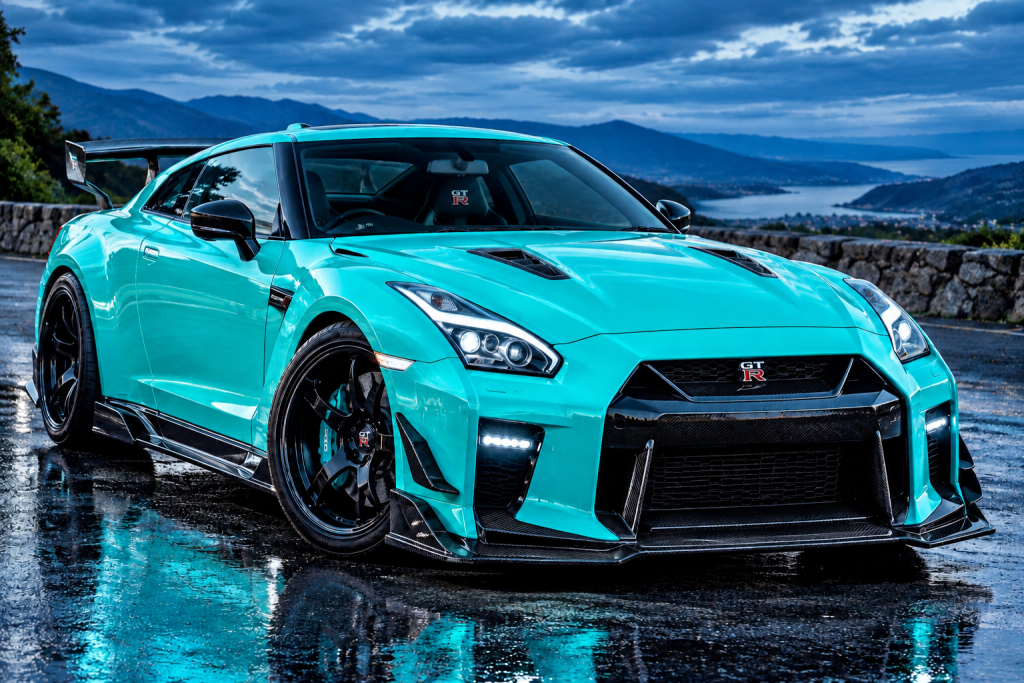
Few cars have shaped a generation like the Nissan GT-R. Known worldwide as Godzilla, this Japanese sports car proved for almost two decades that a road car could rival European supercars at a fraction of the price. In this article we cover its history, its engine, its versions, its price, its future and, of course, the visual star of the image: a turquoise GT-R with black carbon fiber details that leaves nobody indifferent.
What Is the Nissan GT-R?
The Nissan GT-R is a high-performance sports coupe with a twin-turbo V6 engine, all-wheel drive and a dual-clutch transmission. The letters stand for “Grand Touring Racing,” a philosophy that blends the comfort of a grand tourer with the character of a race car. What made it unique was its approach: instead of relying on a huge engine or exotic materials, Nissan bet on technology, electronics and traction to squeeze out every last horsepower.
The result was a vehicle that accelerates like a supercar, brakes with authority and holds a stability that surprised even on wet asphalt. That recipe turned the GT-R into a cultural phenomenon, present in video games, movies, race tracks and thousands of garages.
The History: From Skyline GT-R to Modern Godzilla
To understand the GT-R, you have to go back to 1969, when the first Skyline GT-R (known as the “Hakosuka”) appeared and dominated Japanese racing. After a long pause, the name returned in 1989 with the R32 generation, powered by the RB26DETT engine and the ATTESA E-TS all-wheel-drive system. It was so dominant in competition that the Australian press nicknamed it Godzilla, a title it still carries today.
Then came the R33 (1995) and the R34 (1999), which became a legend thanks to video games and cinema. After the R34, the GT-R split from the Skyline name and was reborn in 2007 as a standalone model: the GT-R R35, designed to take on the best sports cars on the planet.
The R35 Generation: 18 Years of Dominance
The R35 is by far the longest-running and most successful generation. Since 2007, Nissan built about 48,000 R35 GT-Rs worldwide, and production was centered at the Tochigi plant in Japan, the GT-R’s home since 2007. Over those years it received numerous updates to its engine, suspension, interior and aerodynamics. By one enthusiast’s count, it went through seven different updates and facelifts.
That long run had an interesting effect: while rivals were redesigned from scratch, the GT-R was refined year after year. That constant evolution explains why, in 2025, it was still a serious contender against far newer sports cars.
The Heart of Godzilla: The VR38DETT Engine
The soul of the GT-R R35 is the VR38DETT, a 3.8-liter twin-turbo V6. What makes it special is not only its power but how it is built. Each VR38DETT was hand-assembled by a dedicated team of only nine “Takumi” master craftsmen, and every unit carried a nameplate signed by its builder. That artisan tradition gave it the aura of a collector’s item.
Horsepower evolved considerably over the years. The original R35 made 473 horsepower, the standard GT-R later reached 565 hp and the Nismo version 600 hp. In metric terms, the launch car delivered 353 kW and 588 Nm, versus 441 kW and 652 Nm for the Nismo, which uses GT3 race-spec turbos and precision-balanced internals.
For an automotive website, one key point deserves emphasis: the VR38DETT is not “fast” because of sheer displacement, but because of its forced induction, cooling and turbo response engineering.
All-Wheel Drive, Dual-Clutch Gearbox and Chassis
If the engine is the heart, the ATTESA E-TS all-wheel drive is the brain. This system distributes torque between the axles intelligently, sending more power to the rear in normal conditions and shifting it to the front when traction is needed. In practice, this means the GT-R can launch off the line with brutal acceleration, even on wet pavement.
Another unusual decision was mounting the six-speed dual-clutch transmission at the rear axle (transaxle), which improves weight distribution. Add launch control, which allows nearly perfect starts, and large Brembo brakes that withstand sustained punishment on track.
The chassis combines a rigid body with adaptive damping suspension, allowing you to switch between a comfortable mode for daily driving and a firmer one for the track. That’s why the GT-R worked equally well in the city or on a track day.
Performance: Acceleration, Top Speed and the Nürburgring
In numbers, the GT-R is a weapon. Modern versions accelerate from 0 to 100 km/h (0–62 mph) in about three seconds and exceed 300 km/h (186 mph) top speed. But its real calling card was the Nürburgring Nordschleife, where Nissan made the GT-R an obsession. The Nismo version posted lap times around 7 minutes 8 seconds, a figure previously reserved for far more expensive supercars.
Beyond the numbers, what people love about the GT-R is the feeling: the forceful push of the turbos, the deep exhaust note, the firm steering and the confidence of all-wheel drive. It makes even drivers with little experience feel fast, which is why it earned the respect of the specialist press.
GT-R R35 Versions: Premium, T-Spec, Track Edition and Nismo
The GT-R lineup grew over time. These are the most important versions:
- GT-R Premium: the base version, aimed at comfort and daily use, with leather interior and good equipment. For 2025, the Premium Edition gained a new “Blue Heaven” interior color.
- GT-R Premium Edition T-Spec: a more refined variant with handling improvements and exclusive details. For 2025, the T-Spec and the Track Edition received weight-balanced piston rings, connecting rods and crankshafts that were previously exclusive to the Nismo Special Edition.
- GT-R Track Edition Engineered by Nismo: built for the track, with suspension tuning and weight reduction.
- GT-R Nismo: the top of the range, with race-derived turbos, carbon fiber aerodynamics, upgraded brakes and the most power of any R35.
This variety let buyers choose between a grand tourer usable every day and an almost race-ready track weapon.
The Turquoise GT-R: A Color That Changes Everything
Here we reach the most striking element of the image: the turquoise color. This shade, halfway between aqua, cyan and blue-green, completely transforms the GT-R’s personality. Compared with the classic silver, gray or white, turquoise conveys energy, modernity and a touch of rebellion.
Why Turquoise Works So Well on the GT-R
The GT-R has a body with muscular lines, pronounced wheel arches and an aggressive front end. A vivid color like bright turquoise highlights those shapes and makes them look more sculpted. The contrast with the black elements (grille, spoiler, side skirts and wheels) creates a visually striking combination that is highly photogenic and ideal for ranking content on social media and search engines.
The finish in the image is glossy, with reflections visible on the hood, doors and flanks. That shine, together with the wet asphalt in the background, multiplies the effect: the turquoise reflects on the ground and doubles the sense of depth. The bluish evening light over the mountains completes an almost cinematic scene.
Details That Complement the Color
Judging by the photograph, this GT-R has elements that go beyond a stock model:
- Front splitter and side skirts in carbon fiber with a visible weave look.
- Large rear wing, race-style.
- Hood vents that help evacuate engine heat.
- Black multi-spoke wheels with turquoise brake calipers to match.
- LED headlights with the GT-R’s signature lighting and daytime running lights in the bumper.
- GT-R emblem on the grille and on the interior headrests.
This set-up points to a modified (tuned) example with a custom aero kit. In fact, Nissan never offered turquoise as a catalog color on the R35; the most iconic factory shades were Midnight Purple, Bayside Blue and Ultimate Silver. That’s why a turquoise GT-R is usually achieved with a custom paint job or a wrap (vinyl).
Paint or Wrap: Which to Choose for This Color
- Custom paint: offers the greatest depth and durability, but it is more expensive and can reduce resale value if irreversible.
- Wrap or vinyl: lets you change the color without touching the original paint, protects the bodywork and can be removed. It’s the most popular option for trying a bold shade like turquoise.
If you plan to publish the image on your website, I recommend always mentioning in the caption that this is a customized GT-R, to avoid confusion about the original factory colors.
Aerodynamics and Carbon Fiber
Aerodynamics is key on the GT-R. At high speed, air acts as a brake and can also destabilize the car, so every piece matters. The rear wing generates downforce over the rear axle, the splitter directs airflow under the bumper and the side canards help press the front end to the ground.
Carbon fiber is the star material: it is light, stiff and has an unmistakable technical look. On the Nismo GT-R, carbon is used on the roof, hood and several exterior parts. On a customized car like the one in the image, black carbon contrasts with the turquoise and reinforces that aggressive, race-inspired character.
Nissan GT-R Price
The GT-R‘s price rose over the years. In the United States, the 2024 GT-R started at $121,090, with the T-Spec from $141,090 and the Nismo from $221,090. In Japan, the 2025 model ranged from 14,443,000 to 30,613,000 yen depending on the version.
Because the model is no longer built, well-kept used GT-Rs tend to hold or even increase their value, especially the Nismo, T-Spec and special editions. For anyone seeking an investment that is also a joy to drive, it is one of the most interesting options in the Japanese sports car market.
The End of an Era: Goodbye to the R35
The news that shook enthusiasts was the end of production. After 18 years, the last R35 rolled off the Tochigi line: a Premium Edition T-Spec in Midnight Purple, built for a Japanese customer. The key date was August 2025, and the main reason, according to reports, was that many parts would no longer be possible to manufacture in the future.
North American production had ended earlier, in October 2024.
Will There Be a GT-R R36?
Nissan has made clear the name isn’t disappearing. CEO Ivan Espinosa said this is not a permanent farewell and that a new generation, possibly the R36, remains part of long-term plans, though no timeline or design has been confirmed. Rumors point to an electric or hybrid GT-R tied to the Hyper Force concept and solid-state battery technology. Nissan does not expect that technology to be production-ready before 2028, so the wait could be long.
Since these reports are already some months old, check Nissan’s official news before publishing any claim about the R36 on your site.
Tips for Buying a Used GT-R
If you’re considering a GT-R R35, keep these points in mind:
- Maintenance history: demand invoices for oil, transmission fluid and differential changes, which are very specific.
- Dual-clutch gearbox: check for noises or jerks, especially on cars used heavily on track.
- Modifications: a tuned GT-R can be more powerful but also more fragile. Ask who did the work.
- Brakes and tires: they’re expensive to replace, so they affect total cost.
- Origin of the car: Japanese imports may have different regulations and homologation depending on your country.
Tuning and Customization
The GT-R is a perfect canvas for tuning. Specialists offer everything from ECU remaps and titanium exhausts to larger turbos, body kits and competition suspension. Many owners push power beyond 700 hp without losing reliability when the work is done properly.
Aesthetically, the current trend combines eye-catching colors (like the turquoise in our image), black wheels and exposed carbon parts. It’s a formula that works very well in photography and on social media.
Frequently Asked Questions About the Nissan GT-R
Why is it called Godzilla?
The nickname was born with the R32 generation, which dominated competition, and the press compared it to the Japanese movie monster. It has since spread to every generation.
How much horsepower does a GT-R have?
It depends on the version: from about 473 hp on the original R35 to about 600 hp on the Nismo.
Is the GT-R rear-wheel or all-wheel drive?
All-wheel drive. It uses the ATTESA E-TS system, which splits torque between both axles.
Is the GT-R still being made?
No. R35 production ended in August 2025, although Nissan has confirmed it plans a successor.
Does a factory turquoise GT-R exist?
Not in the standard R35 catalog. A turquoise GT-R is normally achieved with custom paint or a wrap.
Is it a good everyday car?
Yes, thanks to its adaptive suspension and comfort, although its fuel consumption and maintenance are those of a supercar.
Conclusion
The Nissan GT-R is much more than a fast car: it is a symbol of Japanese engineering and a key piece of car culture. Its hand-built VR38DETT engine, its all-wheel drive and its ability to beat far more expensive rivals made it a legend. And when it dresses up in bright turquoise with black carbon fiber, it becomes a visual work of art capable of filling any photo gallery. With the R35 retired, every example gains value, and the open question is what the next Godzilla will look like.