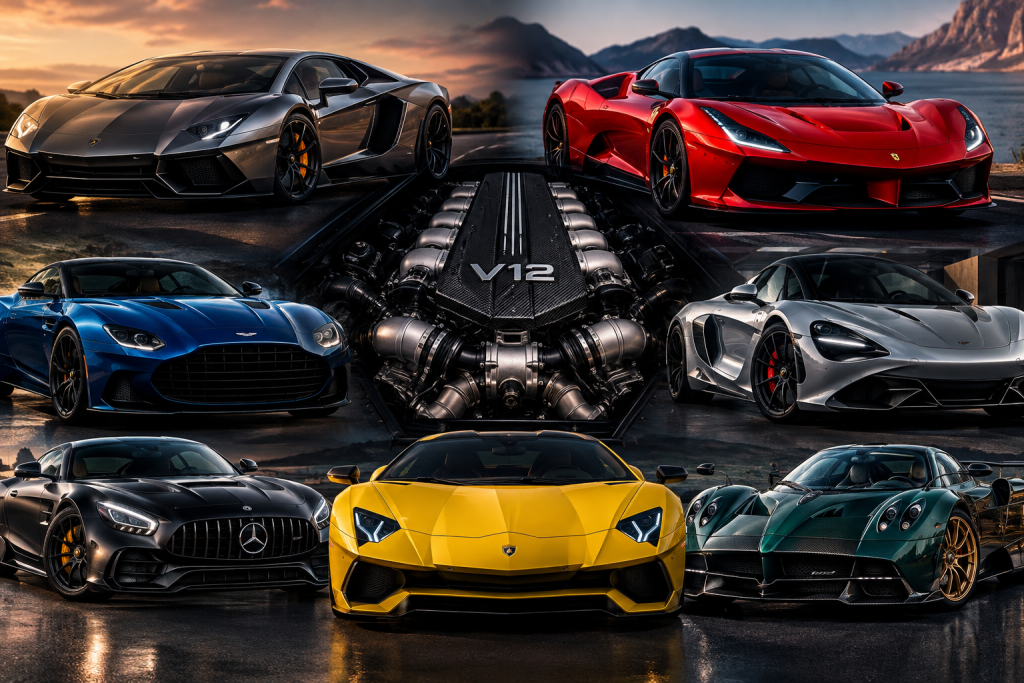
Turbochargers, hybrids and electric motors have taken over the supercar world. The V12 is still the engine many enthusiasts consider the peak of the form: smooth, loud and dramatic in a way few other layouts can match.
This list ranks ten V12 supercars by historical impact, engineering ambition and how much they still matter to collectors. The order is our opinion, so expect some disagreement.
1. McLaren F1 (1992–1998)
The benchmark. Gordon Murray’s F1 used a BMW 6.1-liter V12 with about 618 hp, a central driving position and a carbon-fiber monocoque. In 1998 it set a top speed record of 386 km/h (240 mph) for a production car, and it did it without turbochargers. Only 106 cars were built, counting prototypes and racing versions.
2. Aston Martin Valkyrie (2021–)
A road car with an engine that revs to 11,100 rpm. The Cosworth-built 6.5-liter V12 works with a hybrid system for well over 1,100 hp. Only 150 road cars were planned. It is the closest thing to a Formula 1 car you can register for the street.
3. Ferrari Enzo (2002–2004)
Ferrari’s flagship of the early 2000s used a 6.0-liter V12 with about 651 hp, a carbon-fiber chassis and F1-style paddle shifting. It was limited to 399 cars, and values reflect that.
4. Ferrari F50 (1995–1997)
Its 4.7-liter V12 was derived from a Formula 1 engine, and the engine was a stressed member of the chassis. It made about 513 hp, and just 349 cars were produced. It is raw, loud and one of the last truly analog Ferraris.
5. Pagani Zonda (1999–2011)
A small Italian company built the Zonda around a Mercedes-AMG V12 that grew to 7.3 liters. The track-only Zonda R reached roughly 740 hp. The quad exhausts and handmade detail made the Zonda a design icon.
6. Lamborghini Murciélago LP670-4 SuperVeloce (2009–2010)
The last and wildest Murciélago. Its 6.5-liter V12 made 661 hp, and weight dropped by roughly 100 kg compared to the LP640. Only 350 units were built. If you want the full story, read our Lamborghini Murciélago guide.
7. Lamborghini Aventador SVJ (2018–2021)
The Aventador’s 6.5-liter V12 reached 759 hp here, paired with active aerodynamics. It is a modern, extreme take on the naturally aspirated formula, and one of the last of its kind.
8. Ferrari 812 Superfast (2017–2022)
A front-engined grand tourer with a 6.5-liter V12 producing about 789 hp, with a redline near 8,900 rpm. It is proof that a V12 can be brutally fast and still feel usable every day.
9. Ferrari LaFerrari (2013–2018)
Ferrari’s first hybrid flagship paired a 6.3-liter V12 with an electric system for about 949 hp combined. Only 499 coupes were built. It is controversial among purists because of the hybrid system, but its performance was extraordinary.
10. Lamborghini Diablo (1990–2001)
The car that defined the poster-wall supercar of the 1990s. The 5.7-liter V12 produced around 485 hp in early cars, and Lamborghini claimed a top speed above 320 km/h. It was difficult to drive and unforgettable.
Honorable mentions
- Ferrari 599 GTO: a road-legal homage to track racing
- Mercedes-Benz CLK GTR: a race car with a license plate
- Lamborghini Countach: the original wedge, with its V12 behind the cabin
Why the V12 still matters
A V12 is naturally balanced, which makes it smooth, and it can rev very high without the vibration of smaller engines. It also has a distinctive sound that turbocharged engines struggle to copy. Emissions rules and electrification are making new V12s rare, which is why these cars keep gaining value.
Frequently Asked Questions
What is the fastest V12 supercar ever?
The McLaren F1 held the production-car record at 386 km/h (240 mph) for years. Newer V12 cars can match or beat it on paper, but the F1 did it naturally aspirated.
Which V12 supercar is the most collectible?
The McLaren F1 sits at the top of the market, followed by limited Ferrari models such as the Enzo and F50.
Are V12 supercars being discontinued?
Several manufacturers have moved to hybrids, but V12 engines are still produced in limited numbers, often with electric assistance.
Figures are manufacturer claims and vary by market and source.